June 17, 2026
Key Takeaways:
- The emerald ash borer kills by starving the tree, not by chewing it down. Larvae sever the vascular layer just under the bark.
- A standing dead ash dries out and turns brittle within a season or two, which is what makes it dangerous to people and property.
- The earliest signs show up at the top of the canopy, where damage is hardest to see from the ground.
- The federal EAB quarantine ended in 2021. The realistic goal now is managing infested trees, not stopping the beetle.
- Removing an infested ash while it still has structural integrity is safer and cheaper than removing one that has been dead for years.
How the beetle got here, and why ash trees can’t fight it
The emerald ash borer (Agrilus planipennis) is a wood-boring beetle native to northeastern Asia. It was first identified in southeast Michigan in 2002, though researchers believe it had been established for roughly a decade before anyone noticed. It almost certainly arrived in solid wood packing material and then moved across the region the way most invasive forest pests do, by hitching a ride in firewood and ash logs hauled from one place to another.
The reason it has been so destructive comes down to evolutionary history. North American ash species, including the white and green ash common throughout Genesee County, never evolved alongside this beetle. They carry no meaningful defenses against it, and the beetle has few natural controls here. The result is a pest that kills healthy, mature trees just as readily as declining ones. Across Michigan, EAB has been responsible for the death or damage of tens of millions of ash trees.
What the beetle actually does inside the tree
This is the part most homeowners misunderstand. The adult beetle is not the problem. The adults nibble a little foliage in early summer and lay eggs in bark crevices. The damage is done by the larvae.
After hatching, larvae tunnel through the outer bark and begin feeding on the phloem and cambium, the thin living layer just beneath the surface. That layer is the tree’s plumbing. Phloem carries sugars produced in the leaves down to the roots, and the cambium is where new conductive tissue forms. As larvae feed, they carve winding, S-shaped galleries through this layer. Enough of these galleries, and they effectively girdle the tree from the inside, cutting the connection between the canopy and the roots.
Once that connection is severed, water and nutrients can no longer move efficiently. The upper canopy is farthest from the roots and feels it first, which is why decline almost always starts at the top and works down. The tree is not being eaten so much as it is being slowly starved and dehydrated. Most infested ash trees die within three to five years, and by the time obvious symptoms appear at eye level, the tree has usually been compromised for a year or more.
Why a dead ash is a structural problem, not just a dead tree
A dead maple or oak can often stand for years and come down on a reasonable schedule. An ash killed by EAB is different, and this is the detail the original framing glossed over.
Because the beetle disrupts the tree’s ability to hold and move moisture, the wood dries from the inside out and loses its elasticity quickly. Within a season or two of death, the trunk and limbs become noticeably brittle. Decay fungi move in and accelerate the breakdown of the wood’s load-bearing fibers. The outward shape of the tree can still look solid while its internal strength is mostly gone.
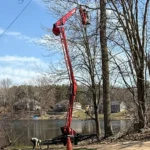
That combination is what makes these trees hazardous. Brittle limbs and even whole trunks can fail suddenly under wind or ice load, with little of the gradual leaning or cracking that signals failure in healthier species. It also changes how the tree has to be removed. Climbing a brittle ash is genuinely unsafe, because the limbs cannot be trusted to hold a climber’s weight, so structurally compromised trees often require a crane and controlled rigging rather than traditional climbing.
Local conditions that raise the stakes
Genesee County and the surrounding Fenton, Linden, and Grand Blanc area add their own pressures. Heavy spring rain saturates the region’s clay-heavy soils, which weakens root anchoring in trees that are already failing. Freeze-thaw cycles and the ice and wind events common to Michigan winters then load those brittle, dead limbs at exactly the wrong time. Many of these ash trees were planted decades ago and now sit close to homes, driveways, fences, and power lines, so when one fails, there is usually something in the way.
How to recognize an infested ash on your property
The signs and symptoms of EAB progress from the top down, so look up first.
- Canopy thinning or dieback at the crown while lower branches stay green is the classic early signal.
- Epicormic sprouting, small leafy shoots emerging directly from the trunk or base, is the tree’s stress response to the upper canopy dying.
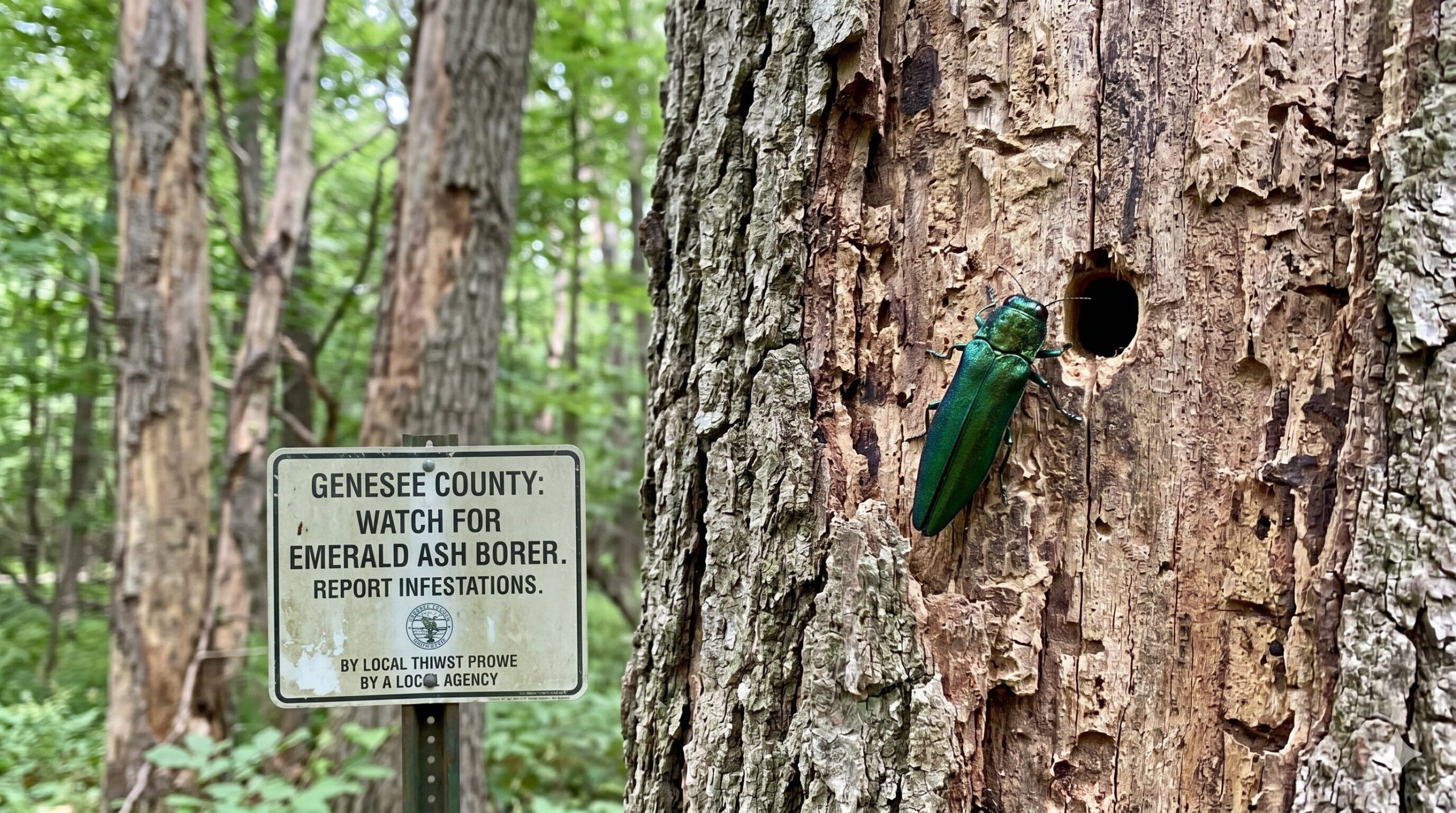
- D-shaped exit holes about one eighth of an inch wide appear after adults emerge in late spring. The flat-sided D shape distinguishes them from the round holes left by native borers.
- Woodpecker flecking, patches where birds have stripped outer bark to reach larvae, often shows up before people notice the beetle at all.
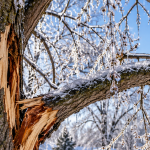
- Bark splitting that reveals the S-shaped galleries underneath confirms an established infestation.
Timing and removal
If an ash shows less than about 30 percent canopy decline, preventative trunk injections may still be worth investigating with an arborist. Past roughly half the canopy, the tree is functionally finished and the conversation shifts to removal.
Delay almost always raises both the cost and the risk. A tree that has been dead for two or more years cannot be climbed safely, which means more machinery, more rigging, and more labor for the same removal. There is also a liability angle. If a brittle limb fails and damages a neighbor’s property or a power line, a visible, untreated infestation can make negligence harder to argue against.
Firewood and the spread, as the rules stand now
The federal EAB quarantine was removed in January 2021 because the beetle was already too widespread to contain, and Genesee County sits in a fully infested part of the state. There is no realistic chance of eradication. What still matters is not making the spread worse and not introducing other pests. The guidance is simple: buy firewood where you burn it, burn what you buy, and never move ash wood out of the area. Bringing ash firewood onto state parks and forest land also remains restricted. Properly disposing of removed ash debris on site or locally is part of doing the job responsibly.
Working with a local team
When it comes to managing the emerald ash borer in Fenton, Linden, Grand Blanc, Holly, and across Genesee County, Holtslander & Sons Tree Service brings the equipment and judgment these trees require. Removing a brittle, EAB-killed ash is not a do-it-yourself job, and we handle it with the crane support, rigging, and 24/7 emergency response that hazardous trees demand. We work cleanly, price transparently, and respect your property. If you have an ash tree you are unsure about, contact us for a free estimate before the next storm makes the decision for you.
This article has been reviewed by a certified arborist for technical accuracy.