October 1, 2026
Key Takeaways
- Ice storms can cause internal wood damage that isn’t visible from the ground, even when a tree appears to have come through the event unharmed.
- Included bark unions are especially vulnerable to failure under the added weight of ice accumulation.
- Root plates can loosen from uneven ice loading on the canopy, affecting a tree’s anchorage without visible signs above ground.
- Damage from an ice storm can take weeks or months to fully manifest as limb or trunk failure.
- A professional inspection after a significant ice event is the most reliable way to catch hidden structural weaknesses before they fail.
An ice storm can leave a tree appearing healthy and intact while causing internal damage that may not become visible for weeks or months. Damage beneath the bark, at branch unions, or within the trunk can weaken the tree even when no major limbs have fallen. This is why a professional inspection can be important after an ice storm, even when the immediate damage appears minor.
Unlike wind damage, which often causes visible breaks and fallen branches during the storm, ice damage can develop more gradually. The weight of accumulated ice places significant stress on branches, joints, and wood fibers without always causing immediate failure. As the tree continues to experience wind, snow, and temperature changes, weakened areas may eventually crack or fail.
Because these problems can remain hidden, the condition of a tree immediately after an ice storm does not always tell the full story. A dedicated tree service firm in Fenton, Michigan can perform post-storm assessment to identify weakened branches and structural concerns before they create a greater safety risk.
How Ice Weight Creates Micro-Fractures
Ice accumulation adds substantial weight to branches, sometimes multiplying a limb’s normal load several times over. That added weight can cause micro-fractures in the wood fibers that never fully separate the branch, but do compromise its strength. These hairline cracks are frequently invisible from the ground and may not become apparent until the branch fails under a much lighter load, such as normal wind, months later.
This delayed failure pattern is one of the more counter-intuitive aspects of ice storm damage. A homeowner may reasonably assume that if a tree survived the storm itself without dropping limbs, the risk has passed, when in fact the storm may have simply set the stage for a future failure under far less dramatic conditions.
Ice thickness, storm duration, and how much of the canopy was coated all influence how much fracturing occurs, which is why two trees standing next to each other can come through the same storm with very different levels of hidden internal stress.
Included Bark Unions: A Common Failure Point
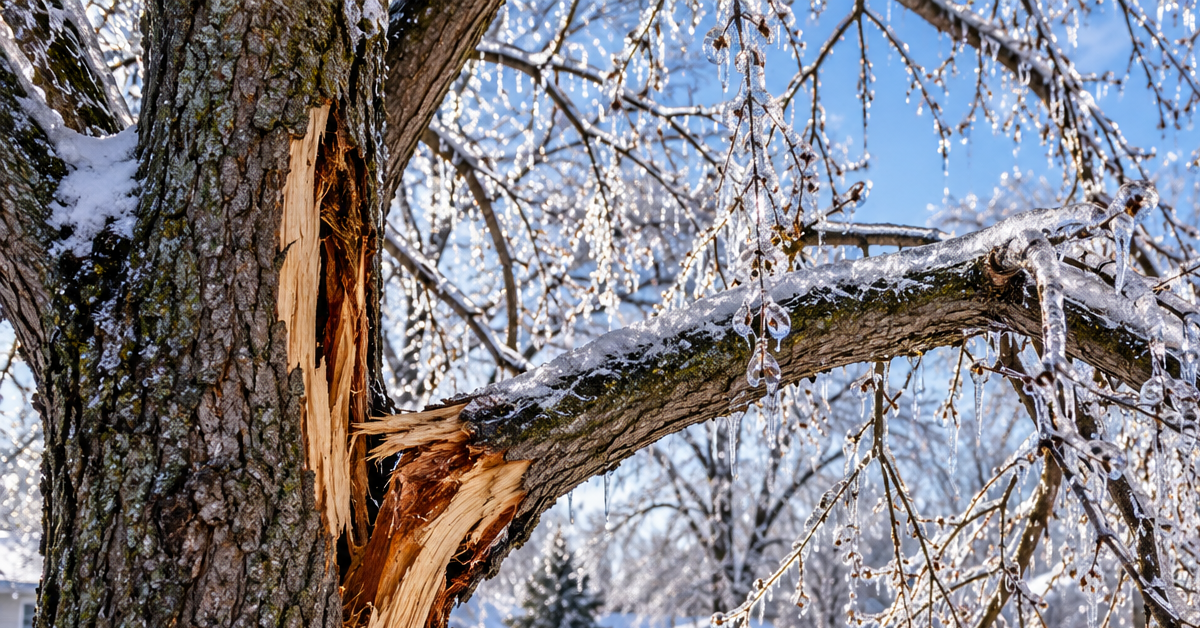
Included bark, a common feature where two branches or trunks grow at a tight angle and bark becomes trapped between them, is especially vulnerable during ice events. The bark itself doesn’t have the strength of solid wood, so when ice-laden limbs pull outward or downward, included bark unions are often the first point of internal failure.
A split may begin here and travel downward into the trunk without ever fully separating the limb during the storm itself. Because included bark unions are a structural feature that develops over years of growth, they’re often present well before an ice storm occurs.
A pre-storm inspection that identifies these weak unions can allow for corrective pruning or cabling before a major ice event puts them under extreme stress.
Species with a natural tendency toward tight branch angles, including certain maples and ornamental pears, are more prone to developing included bark over time, which is worth factoring into both new plantings and ongoing maintenance decisions for existing trees.
Root Plate Loosening Below Ground
Root systems can also be affected, particularly when ice accumulates on a heavy, lopsided crown. The uneven weight distribution can rock or shift the root plate slightly, loosening the tree’s anchorage in the soil even if the trunk and canopy appear unchanged. This kind of damage is difficult to detect without a physical inspection of the root flare and surrounding soil.
Because this type of damage occurs below ground, it’s among the hardest for a homeowner to identify without professional help. Subtle soil cracking or heaving near the base of the trunk is sometimes the only visible clue, and even that can be easy to overlook or mistake for normal ground movement.
Trees with a lopsided or asymmetrical canopy, whether from prior pruning, nearby structures, or natural growth patterns, are generally more susceptible to this kind of uneven ice loading than trees with a well-balanced, symmetrical crown.
What an Inspection Looks For
Because so much of this damage is internal or below ground, visual assessment from a distance is not enough to rule out risk. An arborist inspecting a tree after an ice storm typically checks for sap weeping from unseen cracks, soil disturbance around the base, sound changes when tapping the trunk, and any subtle changes in lean or branch position compared to before the storm.
Some of these signs, like a slight change in trunk lean, are only noticeable when compared against a known baseline, which is part of why homeowners who have photos or clear memory of a tree’s pre-storm appearance can help an arborist assess change more accurately.
A thorough inspection typically takes into account the tree’s species, age, and prior condition as well, since older trees or those with a documented history of storm damage generally warrant closer scrutiny than younger, previously healthy specimens.
Addressing Damage Before It Becomes an Emergency
Addressing these issues early, through corrective pruning, cabling, or in some cases tree removal, is generally far less costly and safer than waiting for a compromised tree or limb to fail on its own schedule. A limb that fails predictably during a planned removal is a very different situation than one that fails unexpectedly during a later storm or windy afternoon.
For trees with known included bark unions, prior storm damage, or other risk factors, scheduling a follow-up inspection after any significant ice accumulation is a reasonable standard practice, even when the tree shows no obvious signs of distress immediately after the event.
Property owners who are uncertain whether a specific tree warrants this kind of follow-up can generally rely on a simple rule: if a tree has any documented history of prior damage, cracking, or lean, it’s worth the relatively modest cost of an inspection compared to the risk of an unexpected failure later on.
How Holtslander & Sons Tree Service Can Help
Holtslander & Sons Tree Service can help Genesee County property owners identify hidden tree damage following an ice storm. Our arborists inspect branches, trunks, branch unions, root flares, and surrounding soil for signs of structural weakness.
Holtslander & Sons Tree Service’s licensed arborists can identify cracked or weakened limbs that may become hazardous during future storms or periods of strong wind. Acting early can reduce the risk of unexpected limb or tree failure near homes, driveways, and other structures. If damage is found, we can recommend the appropriate course of action, whether that involves corrective pruning or, when necessary, safe tree removal.
Holtslander & Sons Tree Service can conduct a professional post-storm assessment to give homeowners a clearer understanding of their tree’s condition and how best to manage any risks.
Frequently Asked Questions About the Impact of Ice Storm on Trees in Genesee County, Michigan
Can a tree look fine after an ice storm but still be damaged?
Yes. Ice storms often cause internal micro-fractures, weakened branch unions, or root plate loosening that aren’t visible from the ground, even when a tree shows no obvious external damage.
How long after an ice storm can hidden damage cause a tree to fail?
Hidden damage can take weeks or months to result in visible limb or trunk failure, often triggered by a much smaller subsequent wind event rather than the original ice storm itself.
Why are included bark unions more likely to fail during ice storms?
Included bark lacks the strength of solid wood, so when ice-laden limbs pull outward or downward, these weak unions are often the first point of internal failure.
Can root damage from an ice storm be seen without professional help?
Rarely. Root plate loosening typically requires a physical inspection of the base and surrounding soil, since only subtle clues like minor soil cracking may be visible from the surface.
When should a tree be inspected after an ice storm?
A thorough inspection is generally best scheduled once ice has fully melted, typically within one to two weeks, allowing cracks, leaning, and soil disturbance to be assessed safely and accurately.
Summary Checklist: Post-Storm Tree Damage Assessment
| Evaluation Area | What to Confirm |
| Visible limb damage | Broken, hanging, or cracked branches after the storm |
| Trunk and branch unions | Signs of included bark separation or new cracking |
| Root plate stability | Soil heaving, cracking, or lean near the base |
| Sap weeping | Indicators of unseen internal cracks |
| Sound testing | Changes in trunk sound consistent with internal decay or cracking |
| Baseline comparison | Photos or notes on the tree’s pre-storm appearance |
| Follow-up plan | Corrective pruning, cabling, or removal recommendations |
Final Advice
Ice storms can leave a tree looking undamaged while quietly compromising its internal structure, from micro-fractures in the wood to loosened roots below ground. Because so much of this damage isn’t visible without a hands-on inspection, waiting to see whether a tree simply fails on its own is not a reliable strategy for managing risk.
Holtslander and Sons Tree Service recommends scheduling a professional inspection after any significant ice accumulation, particularly for trees with a known history of included bark unions or prior storm damage, so hidden weaknesses can be addressed before they turn into an emergency.