July 24, 2026
Many hazardous trees in Fenton, MI often show warning signs months or years before failure, though some failures can occur without apparent precursors. Dead branches, trunk decay, root damage, and structural defects can all increase the risk of falling limbs or complete tree failure during Michigan storms. Knowing how to identify these warning signs early can help protect your home, vehicles, and family while reducing the cost of corrective tree care.
In Fenton and throughout Genesee County, the combination of mature tree canopy, clay-heavy soils in low-lying areas, seasonal ice loading, and increasing invasive pest pressure creates a specific set of tree hazards that repeat themselves on residential properties. Knowing what those hazards look like and where to find them on your property is one of the most practical things you can do as a homeowner.
This guide covers the most common hazards we find on Fenton-area properties, how they develop, and what they look like when you know what to search for.
Top Signs a Tree May Be Hazardous
- Dead branches in the canopy
- Mushrooms growing near the trunk base
- A tree that has recently started leaning
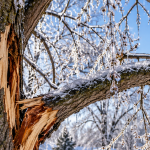
- Cracks in the trunk or major limbs
- Large cavities or hollow sections
- Multiple trunks with a tight V-shaped union
- Visible root damage after construction
Why Trees Fail: The Basic Mechanics
Understanding why trees fail helps you interpret what you’re looking at when you inspect your own property.
Trees are dynamic structures that respond to their environment over time. A tree growing in an open yard develops differently from one crowded by neighboring trees or structures. A tree on a slope anchors itself differently from one on flat ground. When something disrupts the balance between a tree’s structure and the loads it carries, failure becomes possible.
Loads on trees come from several sources: their own weight, wind, ice and snow accumulation, and the weight of additional growth. A healthy tree with a well-developed root system and strong wood structure manages those loads without problem. But when structural defects develop, when root systems are compromised, or when decay weakens load-bearing wood, the margin for error shrinks.
Arborists, the professionals trained in tree risk assessment and management, evaluate trees by looking at the probability that a specific part of the tree will fail, the likelihood that it will hit something if it does, and the consequences of that impact. That framework is useful for homeowners too, even at a basic level.
Hazard 1: Dead or Dying Branches (Widow Makers)
Dead branches are the most common tree hazard on residential properties and the most frequently overlooked. They tend to blend into the canopy when you’re not looking for them, but they become obvious once you know the signs.
What to look for: Branches that are bare during the growing season when surrounding branches are fully leafed. Branches with bark that is beginning to separate or peel away from the wood. Branches that are noticeably lighter in color than healthy wood. Small dead branch stubs throughout the crown are another indicator that larger limbs in that zone may be in decline.
Why they’re dangerous: Dead branches dry out and become brittle. The wood loses its flexibility and the attachment point at the branch collar weakens without living tissue to maintain it. In high winds or under ice loading, these branches fail without warning. The size of a dead branch matters, but even mid-sized limbs falling from height carry enough force to cause serious injury or property damage.
Fenton-specific context: Michigan’s ice storm seasons are particularly brutal on dead branch populations. A branch that looks harmlessly dead through summer becomes a projectile in February after an ice event adds several times its own weight in ice. Dealing with dead branches in late summer or fall is far safer than waiting to see how they survive winter.
Hazard 2: Co-Dominant Stems With Included Bark
This is one of the most commonly misunderstood structural defects in residential trees, and it is widespread across Fenton’s neighborhoods.
A co-dominant stem forms when two or more main trunks grow from the same point and compete for dominance. Rather than forming a strong union where wood fibers from both stems interlock, the bark from each stem gets pressed between them as they grow, creating what arborists call included bark. This bark inclusion prevents proper wood-to-wood bonding at the attachment point.
What to look for: Two trunks of roughly equal diameter rising from the same base, with a tight V-shaped junction between them. If you look closely into that junction and see bark pressed into the seam rather than wood, you’re looking at included bark. The tighter and deeper the V, the more concerning the attachment.
Why it’s dangerous: Included bark attachments fail at lower wind loads than proper branch unions. The failure is typically sudden, producing a split from the junction downward. Given that co-dominant stems often carry half of the tree’s total canopy weight, these failures can be catastrophic.
What you can do: Structural cabling can extend the life of trees with co-dominant stems by distributing dynamic load between the stems. This is a reasonable option when the tree is otherwise healthy and the stems are not yet showing signs of splitting at the junction. A professional assessment will tell you whether the attachment point is still sound enough to benefit from cabling.
Hazard 3: Root Zone Damage and Decay
What’s happening underground affects what you see above ground, and root zone problems often show up as tree failure long before any visible sign appears on the trunk or canopy.
What to look for above ground: Mushrooms or conks growing from the base of the trunk or from roots near the surface. These are the fruiting bodies of wood-decaying fungi, and their presence indicates active decay inside the root system or trunk base. Soft or spongy wood at the base of the trunk when you press against it. A tree that has started to lean recently without any storm event. Cracks in the soil radiating away from the trunk base after high winds.
Common causes in Genesee County: Root zone damage from construction activity on neighboring properties is a significant and underreported hazard. When soil is compacted by heavy equipment or roots are severed during trenching for utilities, the damage may not manifest visibly for several years. By the time the tree shows crown dieback or begins to lean, the root system may already be substantially compromised.
Soil saturation in low-lying areas is another factor. Parts of the Fenton area with heavy clay soil retain water during wet periods, and trees in those zones develop root systems that are more susceptible to fungal decay and structural instability during storm events when the soil is fully saturated.
The Michigan invasive species connection: The emerald ash borer’s destruction of ash trees across Michigan has left many Genesee County properties with ash trees in various stages of decline. As ash trees die from the cambium inward, the root system also loses vitality. Dead ash trees standing in yards may appear structurally intact from the outside while the root connection to the soil has been substantially weakened. These trees fail differently from healthy trees under wind load.
Hazard 4: Trunk Decay and Cavities
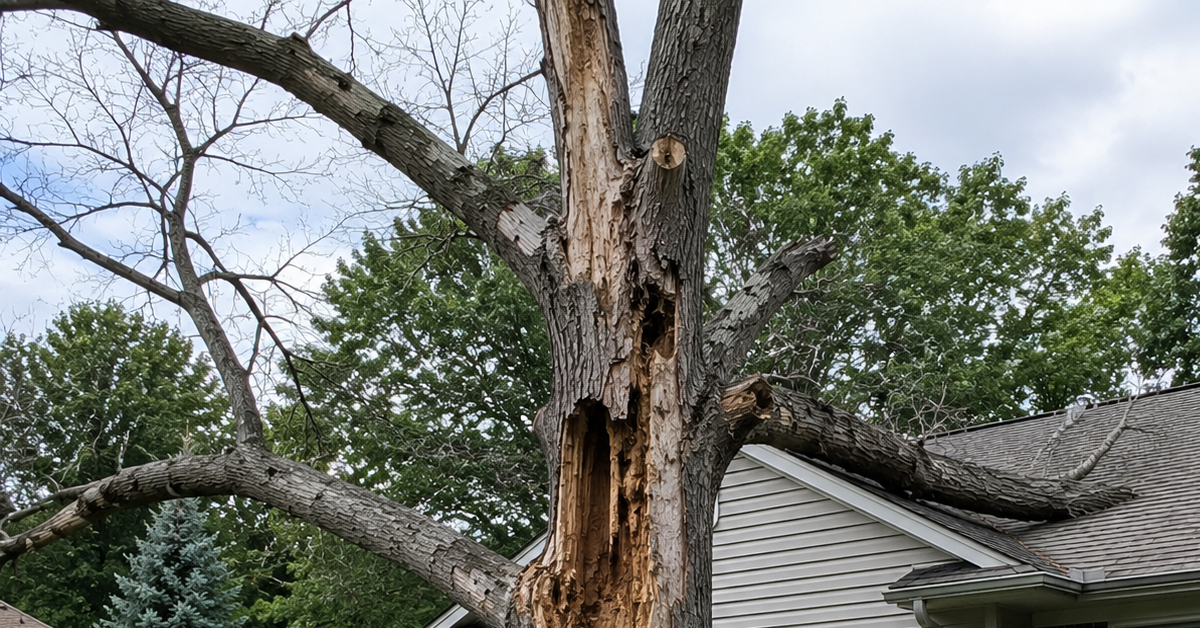
Trunk cavities form when decay removes wood from inside the trunk while the outer shell remains intact. From a distance, the tree can look fine. Up close, the problem is evident.
What to look for: Visible holes or open cavities in the trunk. Bark that sounds hollow when tapped. Areas where bark has fallen away, revealing discolored or soft wood beneath. Elongated vertical cracks in the trunk bark. Weeping sap or staining patterns that suggest internal decay has reached the outer layers.
How serious it is: The extent of internal decay relative to the remaining sound wood determines how serious the risk is. A large tree with a small amount of interior decay may still carry adequate structural wood to be safe. A tree where decay has consumed a significant portion of the trunk’s cross-section is a different situation. Professional evaluation with a sounding mallet or more advanced diagnostic tools gives the most accurate picture.
Hazard 5: Storm-Damaged Trees That Were Never Properly Assessed
After a significant storm, some trees sustain damage that is not visible at ground level. A lightning strike, a partial uprooting from wind, or a major limb failure all affect the tree’s remaining structure in ways that require assessment beyond just looking at what fell.
What to look for: Bark spiraling down the trunk after a lightning strike. An asymmetric canopy following a limb failure that suggests the remaining structure is now unbalanced. A trunk that sounds hollow in new areas that were previously sound. Root plate movement indicated by soil displacement or cracking around the base.
The International Society of Arboriculture’s approach to tree risk assessment emphasizes evaluating trees after storm events specifically because hidden damage from one storm often predisposes a tree to failure in the next one. A tree that survived last year’s ice storm with a hairline crack in a co-dominant stem may not survive the next one.
What We Commonly Find on Fenton-Area Properties
On Fenton-area properties, the patterns repeat themselves predictably. The most common combination we encounter is a co-dominant stem with included bark on a large silver maple, combined with a dead branch population in the upper canopy that has been building for years. The homeowner notices the dead branches because they’re visible from the yard, but the co-dominant stem failure risk at the trunk is the larger hazard.
The second most common situation is a large tree adjacent to a fence or structure with basal decay at the root crown that was not noticed because the trunk looks sound at shoulder height. Checking the base of the trunk, including inspecting soil and root exposure a few inches from the base, is commonly overlooked by homeowners.
Frequently Asked Questions About Tree Hazards in Fenton, MI
How often should trees be inspected for hazards?
For mature trees near homes, driveways, patios, or other frequently used areas, a professional inspection every two to three years is a good baseline. Trees should also be evaluated after major storms, ice events, or any noticeable change in appearance, health, or lean.
Can a tree look healthy but still be dangerous?
Yes. Some serious structural problems, including root decay, internal trunk decay, and included bark, may not be visible from the ground. A tree can have a full canopy and still present a significant failure risk.
What is the difference between a dead tree and a hazard tree?
A dead tree has no living tissue remaining. A hazard tree is any tree, living or dead, that has defects or conditions that increase the likelihood of failure and could impact people, structures, vehicles, or other targets nearby.
How do I know whether a tree needs trimming or removal?
Trimming is often appropriate for removing dead branches, improving structure, and reducing risk. Removal may be necessary when a tree has severe decay, major structural defects, significant root damage, or irreversible decline. A professional assessment can determine the safest option.
What should I do if my neighbor’s tree appears hazardous?
Document any visible concerns and communicate them to your neighbor. If the tree appears to present a significant risk, consider obtaining a written assessment from a qualified arborist. Local ordinances and property laws may also affect how these situations are handled.
Which tree species are more prone to structural problems in Michigan?
Certain species require closer monitoring due to common structural weaknesses. Silver maples often develop weak branch attachments and co-dominant stems. Ash trees may be compromised by emerald ash borer damage. Bradford pears are prone to splitting, while box elders tend to produce brittle wood. Regular inspections help identify developing hazards before failure occurs.
Why Addressing Tree Hazards Early Matters
Tree hazards rarely improve on their own. In most cases, they become more severe over time. A small cavity expands, a co-dominant stem develops a larger crack, and root decay continues to spread beneath the soil. What begins as a manageable issue can eventually lead to branch failure, property damage, or the need for emergency tree removal.
Early identification is almost always safer, less expensive, and less disruptive than dealing with a failed tree after a storm. If you’ve noticed dead branches, mushrooms near the base of a tree, visible trunk decay, or a tree that has recently started leaning, it’s worth having it evaluated before conditions worsen.
Holtslander And Sons Tree Service provides professional tree hazard assessments, tree trimming, and tree removal services throughout Fenton and Genesee County. A qualified inspection can identify potential risks and help you determine the most appropriate course of action. Contact our team today to schedule an evaluation and address potential hazards before they become emergencies.