July 2, 2026
Tree topping is one of the most damaging practices a homeowner can authorize on a property, and it is still common across Genesee County. The reasons it persists are understandable. A tree has grown too large for the space. A storm caused a scare. The branches are touching the roof or shading the garden. A door-to-door contractor showed up after a storm and offered a quick fix at a low price. The homeowner says yes, and a week later, half the canopy is gone.
What follows is a tree that looks ruined for a season, then sends out aggressive shoots that grow back faster than expected. The homeowner thinks the tree has recovered. It did not. The damage is structural, internal, and progressive. Five to ten years later, the same tree is in worse shape than before, often with major failures that put property and people at risk.
Key Takeaways
- Tree topping is the practice of cutting back large branches or the entire crown to stubs, removing 50 percent or more of the leaf-bearing canopy at once.
- Topping is condemned by every major arboricultural authority in North America, including the International Society of Arboriculture and the Tree Care Industry Association.
- A topped tree develops dense, weak regrowth (water sprouts) that is more prone to failure within 5 to 10 years than the original canopy was.
- Topping creates large wounds that the tree cannot compartmentalize, leading to decay, fungal entry, and eventual structural failure.
- In Genesee County, topping is especially destructive on silver maple, oak, ash, and pine, which already face high stress from ice storms, EAB pressure, and oak wilt.
- The professional alternative is proper crown reduction or selective pruning, which addresses size or clearance issues without destroying the tree’s structure.
This guide explains exactly what tree topping is, why every professional arboricultural authority opposes it, what it does to Genesee County trees specifically, and what the proper alternatives are.
What Tree Topping Actually Is
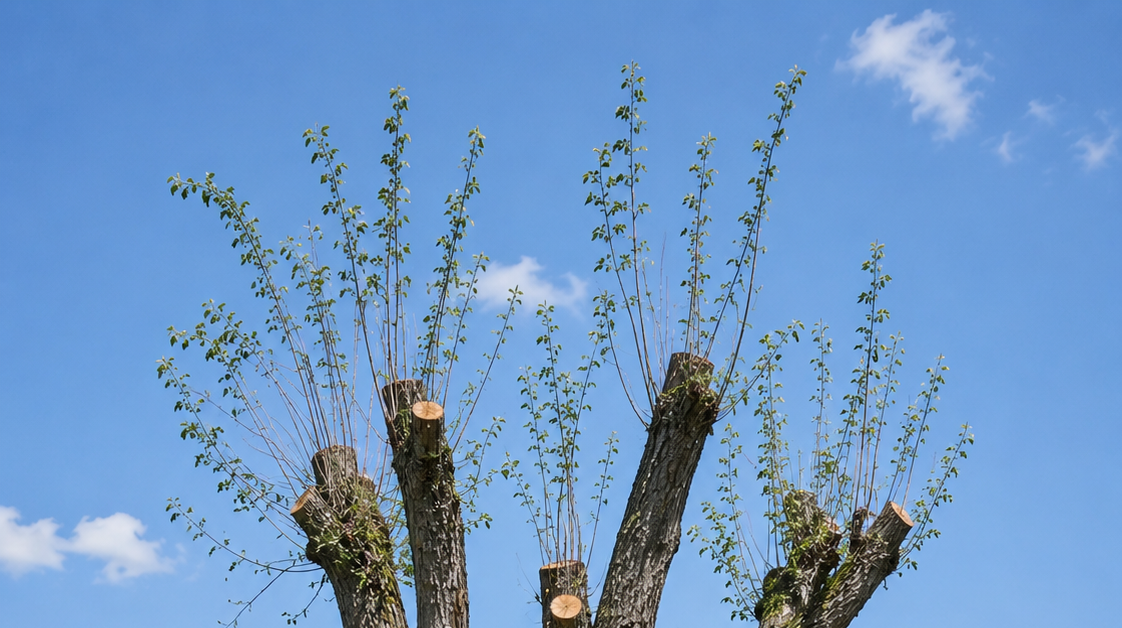
Topping is the indiscriminate cutting of branches to stubs or lateral branches that are not large enough to assume the role of the cut branch. The result is a drastically reduced crown with multiple flat-topped stubs and large internodal cuts. Common variants include:
- Hat-racking: Reducing a tree to its main trunk and large structural branches with all secondary growth removed
- Topping for height: Cutting the top off a tall tree to make it shorter
- Stub cuts: Leaving branches cut mid-section rather than back to a proper lateral or branch collar
- Lion-tailing as a topping variant: Removing all interior growth and leaving only the outer canopy, which destroys the tree’s ability to distribute load
Topping is not the same as crown reduction. Crown reduction is a professional pruning technique that reduces a tree’s size by cutting back to lateral branches large enough to take over as new leaders, with cuts placed at proper angles relative to the branch collar. Topping is fast, sloppy, and destructive. Crown reduction is precise, limited in scope, and preserves the tree’s structure.
The International Society of Arboriculture has published the definitive consumer-facing explanation of why topping hurts trees. The science behind this position has been settled for decades.
Why Every Major Authority Opposes Tree Topping
The opposition is consistent across the entire field:
- The International Society of Arboriculture explicitly identifies topping as an unacceptable pruning practice
- The Tree Care Industry Association does not recognize topping in the ANSI A300 pruning standard
- The USDA Forest Service and university extension services consistently warn against topping in homeowner education materials
This is not a stylistic preference. It is a recognition that topping causes specific, documented, predictable damage to trees that shortens their lifespan and increases hazard risk.
What Topping Does to a Tree Biologically
A tree’s branches are not random. They support a leaf canopy that performs photosynthesis. The size and shape of the canopy are calibrated to the tree’s energy needs and the size of the root system. When a tree loses a large portion of its canopy at once, several things happen, none of them good.
Massive Energy Loss
Trees store energy reserves in their roots, trunks, and branches as starches and sugars. When a tree loses 50 percent or more of its leaf-bearing canopy in a single cut, it loses most of its capacity to produce energy that season. The tree responds by drawing on its stored reserves, which depletes its root system.
Weak, Rapid Water Sprout Regrowth
The hormonal response to topping is dramatic. The tree pushes out dense clusters of fast-growing shoots near each cut, called water sprouts or epicormic shoots. These sprouts grow much faster than the original branches did, but they are structurally weak. They emerge from the bark surface rather than from properly developed branch unions. Their attachment to the parent branch is shallow.
Within 5 to 10 years, these water sprouts grow to substantial size. They are now large branches with weak attachments. They are the branches that fail in the next ice storm or high wind event.
Inability to Compartmentalize Wounds
Trees do not heal in the way animals do. They compartmentalize wounds, walling off damaged tissue from healthy tissue. Small, properly placed pruning cuts allow the tree to seal off the wound through this process. Large stub cuts from topping are too big for the tree to compartmentalize effectively. The wound stays open. Decay fungi enter through the exposed wood. Over years, the decay spreads inward from each topping cut, hollowing out the branches and eventually the trunk.
Sunscald and Bark Damage
Removing a tree’s canopy at once exposes branches and trunk to direct sun that they had been shaded from for decades. Bark on shade-grown branches is thin and vulnerable. Sunscald cracks the bark, creates entry points for borers and decay fungi, and damages the cambium beneath.
Stress Predisposes the Tree to Pests and Diseases
A stressed tree is a vulnerable tree. After topping, a tree is more susceptible to opportunistic insects (borers, scale, aphids) and to diseases it might have otherwise resisted. In Genesee County, this matters because we already have active pest pressure from emerald ash borer and active disease pressure from oak wilt and Dutch elm disease.
Why Topping Is Especially Destructive on Genesee County Trees
Local conditions amplify the damage:
- Silver maples are everywhere in Genesee County, and they are the most commonly topped species. Silver maple is already prone to weak unions and decay. Topping accelerates both problems dramatically. A topped silver maple in Fenton or Flint is often a major hazard within a decade.
- Oaks should never be topped, ever. Oak wilt risk turns large topping wounds into infection vectors during the April 15 to July 15 window. Even outside that window, topping cuts on oaks are large enough that they rarely close, creating long-term decay pathways.
- Ash trees are mostly gone or dying from EAB. Topping a stressed ash accelerates failure. These trees should be assessed for removal, not topped.
- Late-season ice storms test weak attachments. Genesee County experiences late March and early April ice events that load tree branches with hundreds of pounds of ice. Water sprouts on topped trees fail catastrophically under this load.
The combination of local pest pressure, disease pressure, ice storm risk, and high-wind events means a topped tree in Genesee County has a measurably shorter functional lifespan than a topped tree in a milder climate.
Why Homeowners Authorize Topping Anyway
Understanding why topping persists helps homeowners recognize when they are being misled.
Misconception: A Smaller Tree Is a Safer Tree
A topped tree looks shorter for a year or two. Then the water sprouts grow back, often denser and taller than before, with worse structural attachment. A properly pruned tree at the right size is safer than a topped tree at any size.
Misconception: Topping Reduces Storm Risk
Topping increases storm risk over the long term. The weak water sprout regrowth is more likely to fail in wind and ice than the original branches were.
Door-to-Door Storm Contractors
After every major storm, traveling contractors knock on doors offering low-priced “tree work.” Many of these crews top trees because it is fast, requires no skill, and the homeowner does not know what they are paying for. The work is done in a few hours and the contractor moves on. The damage shows up over years.
Cheap Quotes from Untrained Operators
A proper crown reduction takes more time and skill than a topping job. An untrained operator with a chainsaw can top a tree quickly. The price reflects the time, not the skill. Lower bids almost always mean topping or worse.
The Professional Alternative: Crown Reduction and Selective Pruning
If you have a legitimate reason to reduce a tree’s size or clearance, the professional options are:
- Crown reduction: Selectively cutting branches back to lateral branches that are at least one-third the diameter of the cut branch. This preserves the tree’s structure while reducing overall size or addressing clearance issues.
- Crown thinning: Removing selected interior branches to reduce density without changing the overall outline of the tree. Useful for improving light penetration and reducing wind sail.
- Crown raising: Removing lower branches to provide clearance for buildings, sidewalks, or driveways while preserving the rest of the canopy.
- Deadwood removal: Removing dead, dying, or diseased branches without touching healthy structure.
- Structural pruning on young trees: Shaping growth in the first 10 to 15 years of a tree’s life to prevent the structural problems that lead homeowners to consider topping later.
When a tree truly cannot fit the space it is in (planted too close to a structure, conflicting with overhead lines that cannot be moved), removal and replanting with a properly sized species is often the right answer.
What Our Arborists Commonly See in the Field
The pattern repeats across Genesee County. A homeowner inherits or plants a silver maple in a yard that is too small for it. After 30 to 40 years, the tree dominates the space. A storm comes through, breaks a few branches, and the homeowner gets nervous. A contractor shows up with a low quote, and the tree is topped.
Five to eight years later, the same property calls us. The water sprouts are now substantial branches with weak attachments. Two of them have already broken off in storms. There is visible decay where the old topping cuts were made. The tree is now a hazard.
The conversation at that point is usually about removal. The tree cannot be restored. The damage is done. The cost of the original “cheap” topping job has now multiplied into a removal cost plus the years of stress and risk in between.
What Genesee County Homeowners Can Do Right Now
- Refuse to authorize topping on any tree, regardless of how it is described
- Ask any quoting contractor whether the cuts will be made to lateral branches or to stubs. Stubs mean topping.
- Get a written estimate that specifies the pruning approach (crown reduction, thinning, deadwood removal) before signing
- Verify that the crew works to ANSI A300 standards
- Verify ISA Certified Arborist credentials at isa-arbor.com
- Avoid contractors who solicit door-to-door after storms
What not to do:
- Do not assume a low price is a good price for tree work
- Do not let a contractor talk you into topping as a “preventive” measure
- Do not authorize work without seeing the written scope first
When to Call a Certified Arborist
If you have a tree you think needs to be made smaller, call an ISA Certified Arborist before authorizing any work. A proper assessment determines whether the tree can be reduced through professional crown reduction, whether selective pruning is sufficient, or whether the tree’s location makes removal the better long-term answer.
A 20-minute on-site assessment is the difference between preserving a healthy tree for another 30 years and starting a slow decline that ends in failure.
Frequently Asked Questions
Is tree topping legal in Michigan?
There is no state law against tree topping on private property. Some Michigan municipalities have ordinances that restrict topping of city-owned trees or trees in right-of-way zones. Topping remains widely available even though every major arboricultural authority opposes it.
Will topping make my tree safer in storms?
No. Topping creates weak water sprout regrowth that is more prone to failure in storms within 5 to 10 years of the work. Proper crown reduction is the safer approach.
Can a topped tree be saved?
In some cases, restoration pruning over multiple seasons can improve a topped tree’s structure, but the long-term outcome is generally not as good as a tree that was never topped. Severe topping often leads to eventual removal.
What is the difference between topping and crown reduction?
Topping cuts branches back to stubs or to lateral branches too small to assume the leader role. Crown reduction cuts branches back to lateral branches at least one-third the diameter of the cut branch, preserving structure. Topping is destructive. Crown reduction is professional.
How can I tell if a tree was topped?
Look for flat-topped clusters of dense, vertical shoots growing from old large cuts. Look for large stub cuts on the ends of major branches. Look for visible decay around old cuts. A topped tree usually has a distinctive “fist” shape at each old cut where the water sprouts emerged.
How much does proper tree pruning cost compared to topping?
Proper pruning takes longer and requires more skill, so it costs more upfront. The long-term cost is lower because the tree remains healthy, structurally sound, and does not require premature removal.
Should I remove a tree that has been topped?
Depends on the severity of the topping, how long ago it was done, the species, and the tree’s location relative to targets. An ISA Certified Arborist can assess whether restoration is feasible or whether removal is the safer long-term answer.
Need Professional Tree Pruning in Genesee County? Call Holtslander & Sons
If a contractor has suggested topping your tree, get a second opinion before authorizing the work. If you have a tree that has been topped in the past and you are not sure where it stands now, an assessment can tell you whether restoration is possible or whether the tree should be planned for removal before failure happens on its own.
Reach Holtslander & Sons Tree Service for professional pruning, crown reduction, and tree assessments across Fenton, Linden, Grand Blanc, Flint, and the broader Genesee County area.