March 17, 2026
Tree removal pricing depends on several factors that vary significantly from job to job. Rather than focusing on dollar figures that may not reflect your specific situation, this guide explains what actually drives tree removal costs, what to expect from the process, and how to evaluate quotes from local tree service companies.
Understanding these factors helps you compare estimates intelligently and avoid surprises when the work is complete.
Key Takeaways
- Tree size is the single biggest factor affecting removal cost
- Location on your property matters as much as tree size
- Dead or damaged trees often cost more to remove safely
- Stump grinding is typically a separate service
- Most Fenton homeowners don’t need permits for trees on private property
- Always get at least three written estimates before hiring
- Verify insurance coverage before any work begins
Factors That Affect Tree Removal Pricing
Every tree removal job is unique. Here’s what professionals consider when preparing an estimate.
Tree Size
Size is the primary cost driver. Removal pricing is directly tied to height and trunk diameter because larger trees require more equipment, labor, and time to bring down safely.
A small ornamental tree might take one crew member a couple of hours. An 80-foot oak near a house could require a full crew, specialized rigging, and most of a day.
Tree height categories that affect pricing:
- Small trees (under 30 feet): Ornamental trees, young maples, smaller fruit trees
- Medium trees (30 to 60 feet): Mature maples, standard oaks, ash trees
- Large trees (60 to 80 feet): Large oaks, mature pines, old-growth maples
- Very large trees (over 80 feet): Established oaks, large poplars, mature tulip trees
Trunk diameter also matters significantly. A thick trunk means more cutting, more wood to process, and heavier sections to lower or drop.
Tree Species
Wood density affects how long removal takes and what equipment is needed. Hardwoods like oak, maple, and hickory are denser and harder to cut than softwoods like pine or spruce. Hardwood removal typically takes longer and requires more saw maintenance.
Some species present specific challenges:
- Ash trees weakened by emerald ash borer may be structurally compromised and require extra care. The Michigan Department of Agriculture and Rural Development has resources on managing ash tree decline.
- Willow and poplar have brittle wood that can break unpredictably.
- Multi-trunk trees require more planning and cutting than single-trunk specimens.
- Trees with extensive root flare may need additional stump work.
Tree Condition
Healthy trees are generally straightforward to remove because their structure is predictable. Dead, dying, or storm-damaged trees can be more dangerous and time-consuming.
Conditions that increase complexity:
- Dead trees may have compromised structural integrity, making them unpredictable during felling. Limbs can break off unexpectedly.
- Diseased trees might require special handling to prevent spread to other trees on your property.
- Storm-damaged trees may be partially uprooted, tangled in other trees, or leaning dangerously.
- Trees with extensive decay require careful assessment to determine where weak points exist.
Interestingly, a tree that’s already fallen is often less expensive to remove than one that’s still standing, assuming it didn’t land on anything that complicates access.
Location and Access
Where your tree sits on the property significantly impacts the job’s complexity. Trees in open yards with easy equipment access are straightforward. Trees in tight spaces require more labor-intensive techniques.
Situations that increase removal difficulty:
- Proximity to structures: Trees close to your house, garage, shed, or fence require careful sectional removal rather than felling.
- Power lines: Trees near or touching utility lines may require coordination with your power company. According to the Occupational Safety and Health Administration, work near power lines requires specific safety protocols.
- Limited access: Fenced backyards with narrow gates may prevent equipment from reaching the tree. Crews must carry everything by hand.
- Terrain: Steep slopes or wet ground limit equipment positioning and make the job more dangerous.
- Drop zone restrictions: When other trees, landscaping, pools, or structures surround the tree, crews must lower sections with ropes rather than dropping them.
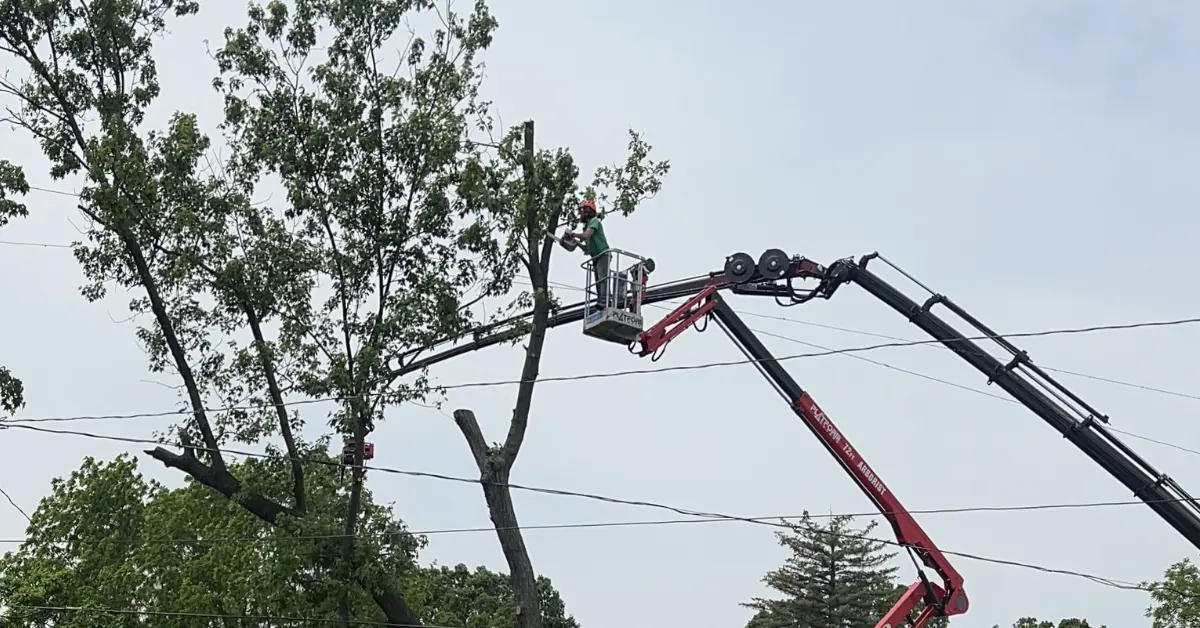
When cranes are needed to lift sections over houses or other obstacles, costs increase substantially.
Number of Trees
Removing multiple trees at once typically costs less per tree than scheduling individual removals. The crew is already on-site with equipment, so additional trees add incremental cost rather than a completely new setup.
If you have several trees to remove, ask for package pricing. Most companies offer meaningful discounts on the second tree and beyond.
Time of Year
Tree service companies are busiest in spring and after major storms. Scheduling during slower periods may reduce wait times and potentially cost.
Considerations by season:
- Late fall through early winter is often the least busy time for tree services in Michigan.
- Winter removal works well for deciduous trees since there’s no foliage to manage. Frozen ground also reduces lawn damage from heavy equipment.
- Spring and summer are peak season, with longer wait times for non-emergency work.
- Post-storm periods see high demand and may command premium pricing for emergency work.
Stump Grinding and Removal Costs
Tree removal typically leaves the stump behind. Most homeowners want it gone, which involves additional work and cost.
Stump Grinding
Stump grinding uses a specialized machine to chip the stump down 6 to 12 inches below ground level. This is the most common and cost-effective option for most situations.
What affects stump grinding cost:
- Stump diameter is the primary pricing factor – larger stumps take more time and wear on equipment
- Number of stumps – most companies charge a minimum service fee, but additional stumps on the same visit cost significantly less per stump
- Root flare – stumps with extensive above-ground roots take longer to grind
- Accessibility – stumps in tight spaces or on slopes may require smaller equipment or more labor
- Depth required – standard grinding goes 6-12 inches deep, but deeper grinding for construction purposes costs more
What to know about grinding:
- Grinding leaves the roots in place to decompose naturally over several years
- The resulting wood chips can fill the hole or be hauled away (hauling may cost extra)
- Ground-level grass can grow over the area within a season
- Grinding is sufficient for most purposes, including replanting the lawn, installing landscape beds, or simply eliminating the tripping hazard
When getting tree removal quotes, ask whether stump grinding is included or priced separately. Some companies bundle it, others treat it as an add-on service.
Full Stump Removal Costs
Full stump removal extracts the entire stump and major roots, leaving a hole that needs filling. This costs significantly more than grinding because it requires heavier equipment, more labor, and more time.
Why full removal costs more:
- Requires excavation equipment rather than just a grinder
- Involves removing and hauling away much more material
- Often requires bringing in fill dirt to replace what was removed
- Takes longer and disturbs more of the property
- May require additional landscape restoration
When full removal is worth the extra cost:
- Installing a foundation, patio, driveway, or fence in that exact location
- Planting a new tree in the precise spot (roots from grinding can interfere with new root development)
- Addressing a stump that’s too close to underground utilities for safe grinding
- Dealing with certain stump-related pest concerns where complete removal is recommended
- Meeting construction code requirements that prohibit buried organic material
Full removal disturbs more of the surrounding lawn and landscaping than grinding, so factor potential restoration costs into your decision.
Leaving the Stump
You can choose to leave the stump, but consider the downsides:
- Creates a tripping hazard
- Can attract termites, carpenter ants, and other insects
- May sprout new growth that requires ongoing maintenance
- Makes mowing difficult
- Looks unsightly as it slowly decays
Stumps can take a decade or more to fully decompose naturally.
Emergency Tree Removal Costs
Storm damage doesn’t wait for business hours. Emergency removal for trees that have fallen on structures, vehicles, or are blocking access commands premium pricing because companies must mobilize quickly, often during difficult weather conditions.
Why Emergency Removal Costs More
- Immediate response premium: Companies must rearrange schedules, call in crews, and potentially turn away other work to respond quickly.
- After-hours rates: Work performed on evenings, weekends, or holidays typically costs significantly more than scheduled weekday service. Some companies charge time-and-a-half or double their standard rates.
- Hazardous conditions: Working around damaged structures, downed power lines, or during ongoing storms requires extra safety measures and specialized equipment.
- Limited competition: During major storm events, demand spikes while supply remains fixed. Companies can be selective about which jobs they take.
- Complexity: Storm-damaged trees are often tangled, partially uprooted, or resting on structures, making removal more complicated than planned work.
Factors in emergency removal costs:
- Timing – middle-of-the-night calls cost more than same-day urgent requests during business hours
- Storm severity – widespread damage means longer wait times and potentially higher prices due to demand
- What the tree fell on – trees on structures require more careful removal than trees blocking driveways
- Utility involvement – if power lines are affected, you may need to wait for the utility company, regardless of what you’re willing to pay
- Insurance coordination – damage to structures may require adjuster approval before removal, which can affect timing
Insurance Considerations for Fallen Trees
If a tree has fallen on your home, contact your insurance company before hiring a tree service. Your homeowners insurance typically covers the removal of trees that damage insured structures, though coverage limits vary by policy.
According to the Insurance Information Institute:
- Most policies cover tree removal when the tree damages a covered structure and fell due to a covered peril like wind or lightning
- Coverage typically has specific limits per tree
- Trees that fell but didn’t damage anything usually aren’t covered for removal
- A fallen tree blocking your driveway or handicap access ramp may be covered under some policies
Document everything with photos before any work begins, and keep all receipts and invoices.
Insurance Coverage Explained
Understanding what your homeowners insurance covers can save significant money after storm damage.
What’s Typically Covered
Standard homeowners policies usually cover tree removal when:
- A tree falls on your home, garage, fence, or other covered structure
- The tree fell due to a covered peril (wind, lightning, ice storm)
- A fallen tree blocks your driveway or handicap access ramp
- A neighbor’s tree falls on your property due to a covered event
What’s Usually Not Covered
Insurance generally won’t pay for:
- Preventive removal of healthy trees (this is considered maintenance)
- Removing trees that fell but didn’t damage anything
- Trees that fell due to neglect, disease, or decay
- Routine tree care and maintenance
- Removal because you simply want the tree gone
If your tree was clearly dead or showing obvious signs of disease before it fell, your claim may be denied. Regular tree maintenance protects both your property and your insurance coverage.
Filing a Claim
After storm damage:
- Document the damage with photos and video before anything is moved
- Prevent further damage if safely possible (cover broken windows, put tarps on damaged roofs)
- Contact your insurance company promptly
- Get estimates from licensed tree services
- Keep all receipts and documentation
- Don’t authorize work beyond emergency stabilization until you’ve spoken with your adjuster
Your insurer may require estimates from multiple companies before approving work.
Hiring a Certified Arborist
For complex situations or when you’re unsure whether a tree needs removal, consult a certified arborist. The International Society of Arboriculture maintains a database of certified professionals.
An arborist can:
- Assess whether a tree can be saved through treatment or pruning
- Identify disease or pest issues that may affect other trees
- Provide documentation supporting insurance claims
- Recommend the safest approach for difficult removals
- Advise on replanting options
The consultation cost is typically modest and can prevent unnecessary removal of salvageable trees.
Frequently Asked Questions
1. What is the average cost of tree removal in Fenton, MI?
Tree removal costs in Fenton typically range from $250 to $1,500+ per tree. Local data indicates that most medium-sized projects fall within the $400 to $900 range. The final price is determined by the tree’s height, diameter, and the complexity of the removal.
2. How does tree size affect the price?
Pricing is heavily influenced by height and canopy spread. While every company quotes differently, you can generally expect the following brackets:
- Small (under 30ft): $150 – $500
- Medium (30ft – 60ft): $500 – $1,000
- Large (over 60ft): $1,000 – $2,500+
3. What is the cost of emergency tree removal?
Emergency removals (after-hours, weekends, or immediately following a storm) are significantly more expensive due to the urgency and risk involved. In Fenton, the average cost for an emergency removal is approximately $990, but can exceed $2,000 if the tree has fallen on a structure or power lines.
4. How much does stump grinding cost in Fenton?
Most companies charge by the diameter of the stump. Prices typically range from $3 to $5 per linear inch, with a minimum service fee of $100 to $150.
- Single Stump: Average $150 – $450.
- Multiple Stumps: The price per stump often decreases (e.g., $40 – $75 for each additional stump) once the equipment is already on-site.
5. Are there hidden fees I should watch out for?
When reviewing a quote, ensure it includes the following, or ask about additional charges:
- Debris Hauling: Some companies chip branches for free but charge $50 – $100 to haul away the heavy trunk sections.
- Log Splitting: If you want the wood kept for firewood, splitting it into logs may cost an extra $35 – $100.
- Travel Fees: If the service provider is based outside the immediate Fenton/Linden area, they may add a small fuel surcharge.
6. Can I save money by removing a tree in the winter?
Yes. Many Michigan tree services offer lower rates during the “off-season” (January through March) to keep their crews busy. Additionally, removing trees over frozen ground can prevent lawn damage that might otherwise require expensive landscaping repairs in the spring.
7. Does Fenton require a paid permit for tree removal?
For most private residential properties, there is no permit fee for tree removal. However, if the tree is in a public right-of-way or on a commercial lot, you must contact the Fenton Zoning Department. If a permit is required for specialized land clearing, fees can range from $100 to $200.
8. Is stump “removal” more expensive than “grinding”?
Yes. Stump grinding (shaving the stump down a few inches below the soil) is the standard and most affordable option. Full stump removal involves heavy machinery to dig out the entire root ball. This is much more labor-intensive and can cost $500+, though it is necessary if you plan to build a structure or plant a new tree in that exact spot.
9. Will my insurance pay for tree removal?
Insurance typically only pays for removal if the tree has fallen on a covered structure (like your house or garage) due to a storm. They generally will not pay to remove a standing dead tree or a tree that fell in the yard without hitting anything.
10. Does Fenton offer any free debris services?
The City of Fenton offers a Brush Chipping Program for residents from May through September. While they won’t cut down your tree, they will chip and haul away branches (up to 12 inches in diameter) placed at the curb for free, which can save you money on the “debris removal” portion of a professional quote.
Conclusion
Tree removal involves numerous variables that make standardized pricing difficult. Focus on understanding what factors affect your specific job, get multiple detailed written estimates, and verify that any company you hire carries proper insurance.
Don’t let price alone drive your decision. A properly insured, professional crew protects your property and keeps the job safe. The apparent savings from choosing an uninsured or inexperienced contractor can evaporate quickly if something goes wrong.
If you’re unsure whether a tree needs removal or could be saved with treatment, consult a certified arborist first. Some problems that look serious can be addressed without taking down the tree, while others require prompt action to prevent property damage or injury.
Sources: