July 1, 2026
Oak wilt is not a future concern in Genesee County. It is a current, confirmed, and active threat across Fenton, Flint, Grand Blanc, Burton, Davison, Flushing, and the surrounding communities. The Michigan Department of Natural Resources lists oak wilt as confirmed in our county. The disease is moving through neighborhoods that have substantial mature red oak populations, which means many of the most beautiful old shade trees in the area are at real risk.
Key Takeaways
- Oak wilt is confirmed in Genesee County, Michigan, as documented by the Michigan Department of Natural Resources.
- Red oaks (including northern red, pin, and black oak) can die within four to six weeks of visible symptoms once infected.
- Pruning oaks between April 15 and July 15 in Michigan is the single highest-risk action a homeowner can take. Sap-feeding beetles carrying the fungus are active during this window and attracted to fresh pruning wounds within minutes.
- Oak wilt also spreads underground through root grafts, meaning a single infected tree can kill an entire cluster of neighboring oaks before the homeowner realizes what is happening.
- Once a red oak shows symptoms, the tree itself is rarely saveable. Treatment shifts to protecting nearby healthy oaks through root graft disruption and preventive fungicide injection.
This guide explains exactly how oak wilt works, why pruning in June is the single worst thing you can do to a Genesee County oak, how to identify the symptoms before it is too late for neighboring trees, and what treatment options actually work.
What Is Oak Wilt? Understanding the Disease Behind Rapid Oak Decline
Oak wilt is caused by a fungus called Bretziella fagacearum. It infects oaks through two pathways:
- Above ground: Sap-feeding beetles (particularly Colopterus and Carpophilus species) carry fungal spores from infected trees and deposit them on fresh wounds, including pruning cuts. The window for active transmission is roughly April 15 through July 15 in Michigan, though risk can extend earlier or later depending on the year.
- Below ground: Oak roots commonly graft to other oak roots of the same species when growing in close proximity. The fungus moves silently through these root grafts from infected to healthy trees, often killing entire clusters before the homeowner realizes anything is wrong.
According to the Michigan Department of Natural Resources, oak wilt is one of the most destructive shade tree diseases in Michigan and has been confirmed in more than 60 counties statewide, including Genesee County.
Which Oaks Are Most at Risk
Oaks fall into two groups, and the disease behaves very differently in each:
- Red oak group: Northern red oak, pin oak, black oak, scarlet oak. These trees die fast. A healthy red oak can be dead within four to six weeks of the first visible symptoms.
- White oak group: White oak, bur oak, swamp white oak. These trees are more resistant. They may decline over several seasons and sometimes recover from limited infections.
The red oaks that line so many older Genesee County streets and dominate the canopy on mature lakefront properties around Lake Fenton, Lobdell Lake, and the surrounding water bodies are the highest-risk trees in the area.
Why You Should Never Prune an Oak in June in Genesee County
This is the single most important point in this article: do not prune any oak in Genesee County between April 15 and July 15. Not a small branch. Not a “quick trim.” Not a dead limb you have been meaning to address.
The reason is mechanical. When sap-feeding beetles emerge in spring, they actively search for fresh wood wounds. They are attracted by the chemical compounds released within minutes of a fresh cut. If those beetles have visited an infected oak (even one many properties away), they may be carrying spores of Bretziella fagacearum on their bodies. They land on your fresh pruning cut, and the spores enter the tree’s vascular system before the wound can begin to heal.
By the time you see symptoms, the fungus is already moving through the tree.
Michigan State University Extension recommends pruning oaks only during the dormant season, generally November through March. If a storm breaks an oak branch during the high-risk window and emergency pruning is unavoidable, the wound should be sealed immediately with tree wound dressing. This is the one and only situation where tree wound paint is recommended by professional arborists.
What Counts as a Pruning Wound
The list is longer than most homeowners realize:
- Saw cuts of any size
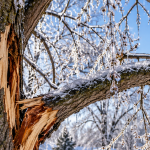
- Branch breakage from storms
- Cuts from chainsaws, pruners, or loppers
- Damage from string trimmers against the trunk
- Damage from mowers hitting roots or root flares
- Cuts during landscaping or fence installation that nick the bark
- Climbing spikes used on living trees (always prohibited under ANSI A300 for non-removal pruning anyway)
If you create a fresh wound on an oak between April 15 and July 15, you have opened a door to a fungus that can kill the tree within weeks.
How to Identify Oak Wilt Symptoms
The symptoms appear in mid to late summer, usually June through August. By the time they show up, the tree is already infected. The signs:
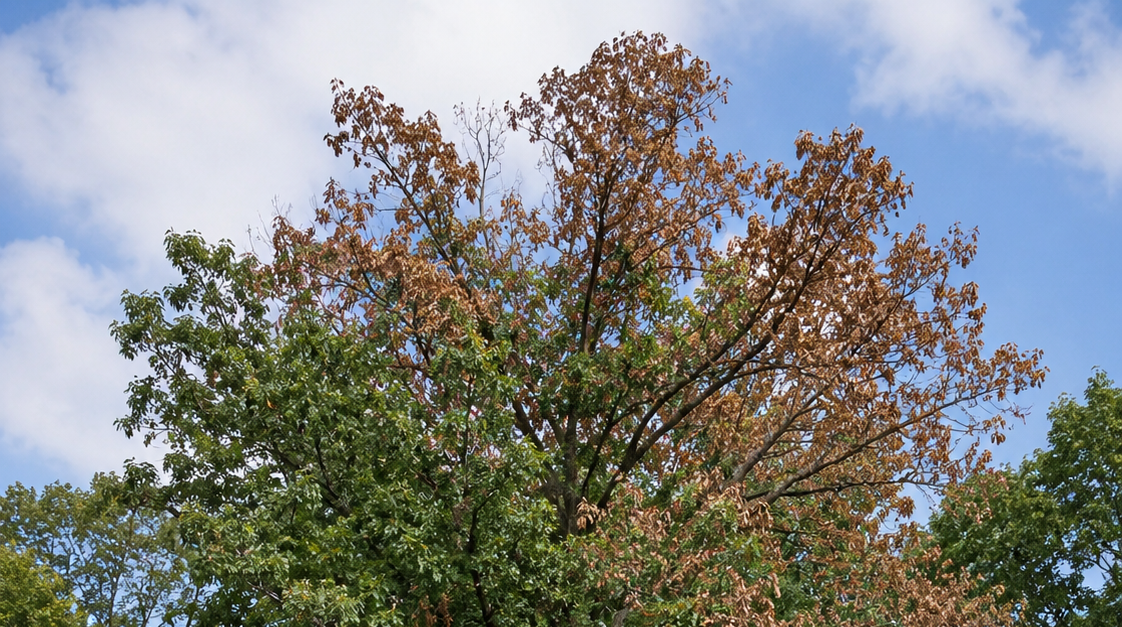
- Sudden leaf wilt: Leaves wilt from the outer edge inward, often turning bronze, tan, or brown while still partly green at the base of each leaf
- Premature leaf drop: Wilted leaves fall while still partly green. This is the textbook that distinguishes oak wilt from drought stress, which causes uniform browning.
- Top-down progression: Symptoms start at the top of the canopy and work down, opposite to most other declines
- Brown sapwood streaking: Cutting into a small affected branch reveals dark brown streaking under the bark in the outer growth ring.
- Rapid canopy loss: A red oak that loses 30 to 50 percent of its leaves in a few weeks is almost always dealing with oak wilt or a similarly aggressive systemic problem
White oak symptoms are subtler. Branch-by-branch decline over a season or two, with leaves dying on individual branches while neighbors look fine.
Why Oak Wilt Spreads So Fast in Genesee County Neighborhoods
The structure of older Fenton, Flint, Grand Blanc, and Flushing neighborhoods is part of the problem. Streets planted with rows of red oaks 60 to 100 years ago now have mature root systems that have grafted underground into continuous networks. A single infected tree at one end of a block can move the fungus through those root grafts and kill three, five, or eight neighboring oaks before the homeowner notices the original tree.
Add to that the storm damage that happens every spring (high winds breaking branches in May and June, hail damage on bark, large limbs torn during straight-line wind events), and the door is open for beetle-vector spread on every block.
The disease is no longer a rare problem. It is something every Genesee County property owner with mature red oaks should plan for.
Oak Wilt Treatment Options
For the Infected Tree
Once a red oak shows symptoms, the tree itself is rarely saveable. Treatment of the symptomatic tree is generally not pursued for red oaks because the fungus moves through the vascular system too fast for fungicide to catch up.
White oaks that show limited symptoms may sometimes be saved through aggressive pruning of affected branches and fungicide injection, but outcomes vary.
For Neighboring Healthy Oaks
This is where treatment matters most. Two methods are used:
- Root graft disruption: A vibratory plow trenches between trees, severing underground root connections. This must happen before symptoms appear in the neighboring oaks. The trench depth required is typically five feet, which means the work needs equipment access.
- Preventive fungicide injection: Propiconazole injected into the root flare of healthy nearby oaks can protect them for up to two years. This is prevention, not a cure, and it must be done by trained professionals using proper equipment.
The right combination depends on tree spacing, root graft likelihood, and how close the symptoms are to the trees you want to protect.
Proper Disposal of Infected Wood
This step matters more than most homeowners realize. Wood from a tree killed by oak wilt can develop fungal mats under the bark that produce new spores. Those spores attract sap-feeding beetles that then carry the infection elsewhere. The Michigan DNR recommends specific handling:
- Chip or debark the wood promptly
- If wood cannot be processed immediately, cover it with clear plastic and seal the edges with soil for at least one full growing season.
- Do not transport infected oak wood (firewood, logs, brush) outside the immediate area.
Many oak wilt expansions in Michigan have been traced to infected firewood transported to new locations.
What We Commonly See In The Field
Oak wilt calls come in waves, usually from mid-July to mid-August, after homeowners notice leaf drop that does not match anything they have seen before. By the time the call happens, the infected tree is often past saving, and the focus is on the cluster of healthy oaks within 50 feet.
The most common mistake we see in Genesee County: homeowners pruning an oak in late May or early June because a branch looks dead, not realizing they have opened a wound during peak beetle activity. Six to eight weeks later, the whole canopy is showing wilt. By then, the underground spread to neighboring oaks may already be underway.
The second most common mistake: contractors doing landscape work in summer who damage oak roots or scrape oak bark with equipment, creating wounds that act exactly the same as a pruning cut.
What Genesee County Homeowners Can Do Right Now
- Do not prune any oak between April 15 and July 15. No exceptions for “small” branches.
- If a storm breaks an oak branch in the high-risk window, paint the wound immediately with tree wound sealer.
- Walk your property each July and check for sudden leaf wilt on red oaks. Photograph anything suspicious with the date noted.
- If a neighbor’s oak shows symptoms, take it seriously even if your own oaks look fine. Underground spread can already be happening.
- Avoid mechanical damage to oak bark and roots year-round, but especially from April through July.
What not to do:
- Do not transport oak firewood from one property to another, especially across county lines.
- Do not let landscapers use oak bark as a chainsaw chopping surface or as a support for ladders.
- Do not assume a tree with symptoms is suffering from drought or another problem. Drought stress does not cause green leaves to drop.
When to Call a Certified Arborist
Oak wilt is a same-week call. If you see sudden summer leaf wilt on a red oak, fast action on the neighboring trees is the difference between losing one tree and losing five. An ISA Certified Arborist verifiable through the ISA Find an Arborist directory should perform a diagnosis and recommend the treatment combination that fits your specific tree spacing.
If you are planning any oak work outside the high-risk window (October through April 15), schedule the pruning during dormancy when transmission risk is at its lowest.
Frequently Asked Questions
Is oak wilt really confirmed in Genesee County?
Yes. The Michigan Department of Natural Resources has confirmed oak wilt in Genesee County and more than 60 other Michigan counties.
Can I prune my oak tree in summer in Fenton, MI?
No. Avoid all oak pruning between April 15 and July 15. Wait until dormancy (typically November through March) for routine pruning.
What if a storm breaks my oak branch in June?
Paint the wound immediately with tree wound sealer. This is the one situation where wound paint is recommended on oaks. If significant damage has occurred, contact a certified arborist within days.
How fast does oak wilt kill a tree?
Red oaks can die within four to six weeks of visible symptoms. White oaks may survive multiple seasons with the disease.
Will fungicide save my red oak that already has wilt symptoms?
Treatment of a symptomatic red oak rarely works. Fungicide injection is used to protect nearby healthy oaks before they are infected, not to cure an already infected tree.
Can oak wilt spread from my neighbor’s tree to mine?
Yes. Oak wilt spreads through underground root grafts between oaks of the same species growing in close proximity, often killing entire clusters of trees within a single property or block.
Should I remove a tree killed by oak wilt right away?
Yes, ideally before the next spring. Dead oak wood can develop fungal mats that continue spreading the disease through sap-feeding beetles.
Is it safe to burn oak wilt firewood?
Burning the wood destroys the fungus, but the period between cutting and burning is when fungal mats can form and release spores. Do not store oak wilt firewood uncovered or transport it to new locations.
Need an Oak Wilt Assessment in Genesee County? Call Holtslander & Sons
If you suspect oak wilt on your property in Fenton, Linden, Grand Blanc, Flint, Burton, Davison, Flushing, or anywhere in Genesee County, the right move is a same-week call. The neighboring trees that can still be saved depend on how fast you move.
Reach Holtslander & Sons Tree Service for diagnosis, root graft disruption, preventive fungicide injection, and proper handling of infected wood.