June 17, 2026
A tree becomes an emergency the moment it threatens a person, a structure, or a utility line. In Fenton, Michigan, that threat can happen in seconds during a severe storm, or build slowly as disease and decay weaken the tree from the inside. The decision is simple. If the tree can fail and hit something that matters, it needs to come down now, not later.
Fenton sits in Genesee County, one of the most tornado-prone areas in Michigan. The region regularly sees severe thunderstorms, straight-line winds over 60 mph, heavy ice storms, and saturated soil that weakens root systems. These conditions turn compromised trees into serious hazards. What looks stable today can fail without warning during the next storm.
Key Takeaways
- A tree is an emergency when it has fallen on or is leaning toward a structure, vehicle, power line, or occupied area.
- Storm damage, severe trunk cracks, root plate lifting, and sudden leaning are all signals that require a same-day professional response.
- Fenton’s location in Genesee County exposes properties to frequent severe weather, including thunderstorms with 60+ mph wind gusts, tornadoes, and ice storms.
- Never attempt to remove a tree that is touching or near a power line. Contact your utility provider and a professional tree service immediately.
- Homeowners’ insurance typically covers emergency tree removal when the tree damages an insured structure. Document everything before cleanup begins.
- Preventive inspections catch hazard trees before they become emergencies, saving thousands in damage and removal costs.
What Qualifies as Emergency Tree Removal?
Not every fallen limb or leaning tree is an emergency. The difference between an urgent situation and a routine removal comes down to three factors: immediate danger to people, active or imminent damage to property, and blocked access to essential routes or utilities.
The USDA Forest Service and the International Society of Arboriculture define a hazard tree as one with a structural defect that makes it likely to fail in whole or in part. When that tree is close enough to hit a home, a car, a pedestrian path, or a power line, it becomes an emergency.
Here are the situations that call for immediate professional response:
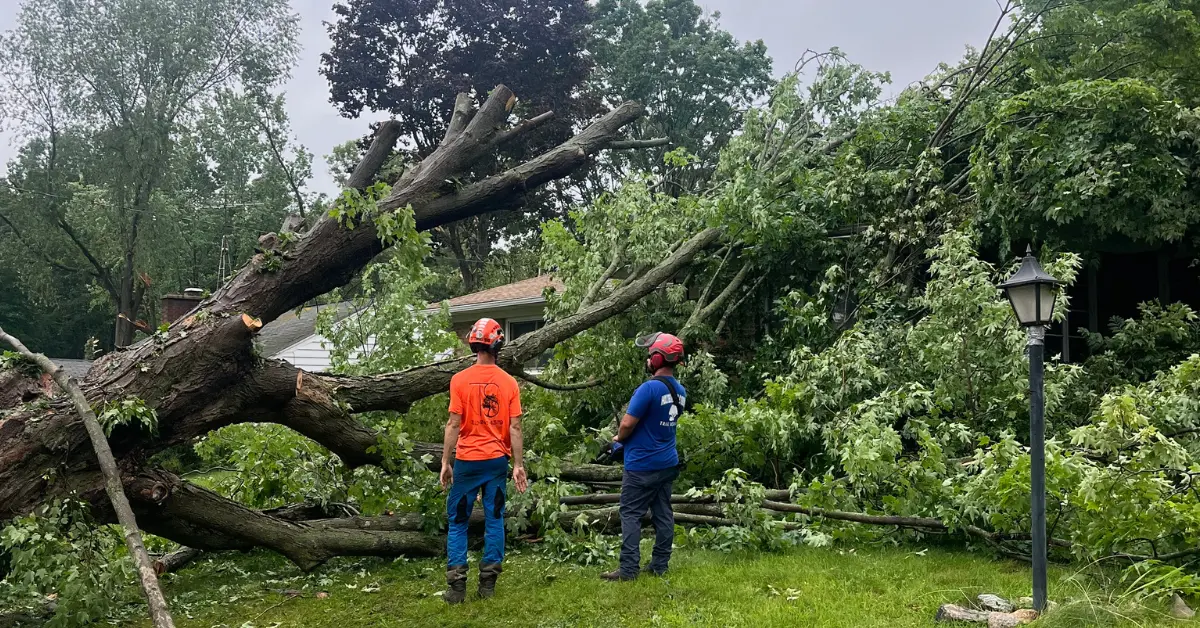
- A tree has fallen on a structure. Whether it is your roof, garage, fence, or shed, a tree resting on a building creates ongoing structural stress. The weight can cause progressive collapse, and shifting during wind or rain can worsen the damage by the hour.
- A tree is leaning suddenly. A tree that develops a noticeable lean overnight, especially with visible soil heaving or root plate lifting at the base, is actively failing. This is different from a tree that has always grown at a slight angle. A new lean means the root system is losing its grip.
- A tree is resting on or near power lines. This is the most dangerous scenario for homeowners. A tree on a power line can energize the ground around it, the trunk, and any metal objects in contact with either. Never approach it. Call your utility provider first, then call a tree service.
- A large limb is hanging but has not fallen. Arborists call these “hangers” or “widowmakers.” A broken limb suspended in the canopy can drop without warning, especially in subsequent wind gusts. If it is over a walkway, driveway, play area, or roof, it needs to come down immediately.
- A tree is blocking access. A fallen tree across a driveway, private road, or emergency access route creates a safety problem that extends beyond property damage. If emergency vehicles cannot reach your home, the tree is an emergency.
- Visible trunk failure. Deep vertical cracks in the trunk, large sections of bark sloughing off to reveal decayed wood beneath, or a trunk that is visibly splitting at a major fork all indicate the tree is in the process of structural failure.
Storm Risks That Make Fenton Properties Vulnerable
Fenton’s geography and climate create a set of conditions that regularly produce tree emergencies. Understanding these risks helps you recognize which trees on your property are most likely to fail during the next weather event.
Severe Thunderstorms and Straight-Line Winds
Southeast Michigan sees frequent severe thunderstorms from late spring through early fall. These storms routinely produce wind gusts between 60 and 80 mph, which is strong enough to snap healthy trunks, uproot mature trees in saturated soil, and send broken limbs through roofing materials. The National Weather Service has documented multiple severe weather events impacting Fenton and surrounding Genesee County communities, including straight-line wind damage and tree debris blocking roads.
Tornadoes
Genesee County holds the record for the highest number of documented tornadoes of any county in Michigan. The historic 1953 Flint-Beecher tornado remains the deadliest in state history, and more recently, an EF-0 tornado touched down near Lake Fenton in July 2022. Tornadoes do not just flatten trees directly in their path. The surrounding wind field can weaken root systems and crack trunks across a much wider area, leaving behind trees that look intact but are structurally compromised.
Ice Storms and Heavy Snow
Winter storms in Michigan load tree canopies with ice and heavy wet snow. Branches that handle their own weight just fine can snap under the added load, especially if they have existing decay, poor attachment angles, or included bark at their unions. Ice storms are particularly dangerous because the damage often occurs overnight, and homeowners wake up to branches draped across power lines and vehicles.
Saturated Soil and Root Instability
Fenton’s spring thaw and heavy rain events regularly saturate the soil. A phenomenon called windthrow, where trees uproot due to weakened soil anchorage, becomes significantly more likely when the ground is waterlogged. Even moderate winds can topple large trees when their root systems sit in saturated clay. This is a leading cause of whole-tree failure in the Fenton area, particularly in low-lying properties near lakes and waterways.
Warning Signs That a Tree Needs Immediate Attention
Most tree emergencies do not come out of nowhere. The tree has been telling you something is wrong, often for months or years, before it fails. Here are the signs to watch for on your Fenton property.
Trunk and Structural Defects
A crack running vertically along the trunk is one of the most serious structural defects a tree can have. It means the internal wood has already begun to separate. Cavities, especially large ones in the lower trunk, indicate advanced decay. Fungal conks or mushrooms growing from the trunk or root flare are direct evidence that wood-decay fungi are actively breaking down the tree’s structural wood.
Root Zone Problems
Soil heaving or cracking near the base of the tree suggests the root plate is shifting. Severed roots from construction, trenching, or utility work compromise the tree’s ability to anchor itself. If more than a third of the root system has been damaged on one side, the tree may lack sufficient support to withstand normal wind loads.
Canopy Warning Signs
Dead branches in the upper canopy that have lost their bark (sometimes called “stag-heading”) indicate systemic decline. Multiple dead branches concentrated on one side of the tree may point to root failure below. A crown that has thinned dramatically over the past one or two growing seasons, especially if accompanied by premature leaf drop or off-color foliage, suggests the tree is dying.
Lean Changes
Every tree has a natural growth orientation. The critical change is a new lean, one that was not there last season. Look at the base of the tree for cracking soil, exposed roots on the side opposite the lean, or a mound of lifted soil. These are signs of active root plate failure.
Emergency Tree Removal vs. Routine Removal: Quick Comparison
| Factor | Emergency Removal | Routine Removal |
| Timing | Same day or within hours | Scheduled days or weeks out |
| Trigger | Active danger to people, structures, or utilities | Tree is dead, declining, or unwanted |
| Risk Level | High: tree may fail further at any time | Low to moderate: tree is stable for now |
| Power Lines Involved | Often yes, requires utility coordination | Rarely |
| Cost | Higher due to urgency, complexity, and after-hours work | Standard rates with predictable scope |
| Insurance Coverage | Typically covered when tree damages insured structure | Usually homeowner’s expense |
| Equipment Needed | Crane, aerial lift, or specialized rigging for difficult access | Standard removal equipment |
| Cleanup Scope | Immediate hazard removal; full cleanup may follow separately | Full removal and site cleanup in one visit |
What to Do When a Tree Emergency Happens
When a tree fails on your property, the first few decisions matter. Here is the sequence that protects both people and your insurance claim.
Step 1: Ensure Everyone’s Safety
Get people and pets away from the tree and anything it might hit if it shifts further. Stay out from under hanging limbs. If the tree is on a power line or you see downed wires anywhere nearby, keep everyone at least 35 feet away in all directions and assume the lines are live.
Step 2: Call Your Utility Provider
If power lines are involved or damaged, call your electric utility immediately. They will de-energize the lines so tree removal can proceed safely. Do not wait for the tree service to handle this step.
Step 3: Document the Damage
Before any cleanup begins, photograph and video everything. Capture the tree’s position relative to your home, vehicles, and fencing. This is critical for National Weather Service storm damage reporting and insurance documentation.
Step 4: Call a Professional Tree Service
Emergency tree removal is not a DIY project. It requires specialized equipment, training, and insurance. A professional crew will assess the full scope of the damage, stabilize the situation, and remove the tree safely without causing additional harm to your property.
Step 5: Contact Your Insurance Company
Most homeowners policies cover tree removal when the tree has damaged an insured structure (your house, garage, or fence). Some policies also cover removal when a tree blocks a driveway or accessibility route. File the claim promptly and share your documentation.
How to Prevent Tree Emergencies on Your Fenton Property
The most cost-effective approach to emergency tree removal is avoiding the emergency in the first place. Regular inspections and proactive maintenance catch problems early, when solutions are simpler and cheaper.
Schedule Annual Tree Inspections
Have a qualified arborist walk your property at least once a year to evaluate tree health and structural integrity. They will look for the defects outlined above, cracks, decay, root problems, lean changes, and canopy decline, and recommend action before a storm makes the decision for you.
Prioritize Trees Near Targets
Focus inspection efforts on trees close to your home, driveway, power lines, play areas, and any other high-use zones. A tree in the back corner of your lot that could fall harmlessly into an open field is a lower priority than the mature oak overhanging your bedroom.
Prune Proactively
Removing dead wood, crossing branches, and limbs with weak attachments reduces the chance of failure during storms. Proper structural pruning performed when trees are young produces stronger branch architecture that withstands wind loads better throughout the tree’s life.
Address Soil and Drainage Issues
If you have trees growing in areas with poor drainage or chronically wet soil, those trees are at elevated risk for root instability. Improving drainage, avoiding soil compaction near root zones, and maintaining healthy root flare exposure all contribute to better tree stability.
Remove Hazard Trees Before Storm Season
If an arborist identifies a tree as a significant hazard, schedule removal during calm weather when crews can work safely and efficiently, rather than paying emergency rates during or after a storm.
Frequently Asked Questions
How do I know if my tree needs emergency removal or can wait?
If the tree is touching a structure, leaning toward an occupied area, resting on a power line, or has a large broken limb hanging over a high-use zone, it is an emergency. If the tree is dead but standing upright and not near any target, you likely have time to schedule a routine removal.
How much does emergency tree removal cost in Fenton, Michigan?
Costs depend on the tree’s size, location, complexity, and whether it involves power lines or structural damage. Emergency work typically costs more than scheduled removals due to urgency, after-hours labor, and specialized equipment needs. Always get a written estimate before work begins.
Will my homeowners insurance pay for emergency tree removal?
In most cases, yes, if the tree has damaged a covered structure like your home, garage, or fence. Many policies also cover removal when a tree blocks your driveway. Review your specific policy and file the claim with photos and documentation as soon as possible.
Is it safe to remove a tree myself after a storm?
No. Storm-damaged trees are unpredictable. Limbs under tension can spring violently when cut. Partially uprooted trees can shift without warning. And any situation involving power lines is immediately life-threatening. Always hire a licensed, insured professional.
How quickly can a tree service respond to an emergency in Fenton?
Reputable tree services offer 24/7 emergency response. During widespread storm events, demand surges and response times may increase. Having an established relationship with a tree service before storm season gives you priority when you need it most.
What should I do if a tree falls on my car?
Move away from the vehicle. Do not attempt to drive out from under the tree. Call your auto insurance provider (comprehensive coverage typically applies), document the damage with photos, and contact a tree service for removal.
Can a leaning tree be saved, or does it always need removal?
It depends on why it is leaning. A tree that has always grown at a slight angle and has no root disturbance is often stable. A tree that has developed a new lean with soil heaving at the base is actively failing and should be removed. An arborist can assess the difference.
What happens if my neighbor’s tree falls on my property?
In most cases, your homeowners’ insurance covers the damage to your property regardless of where the tree originated. Your insurer may pursue reimbursement from your neighbor’s policy if the neighbor was aware the tree was hazardous and failed to act.
Should I be worried about trees near my house after every storm?
After any significant storm, do a visual walk-around. Look for new leans, hanging branches, cracks in trunks, and lifted soil at tree bases. If anything looks different from before the storm, call an arborist for an evaluation. Early detection prevents emergencies.
Are certain tree species more prone to failure in Fenton?
Silver maples, willows, and box elders are known for brittle wood and weak branch attachments. Bradford pears split frequently at their narrow crotch angles. Large pines can uproot in saturated soil due to shallow root systems. These species deserve extra scrutiny during inspections.
How far in advance should I have my trees inspected before storm season?
Late winter or early spring is ideal. This gives you time to schedule any recommended removals or pruning before severe weather typically begins in late April and May. An annual inspection before each storm season is a solid practice.
Does Fenton have any local ordinances about tree removal?
Fenton does not require permits for tree removal on private residential property in most cases. However, some homeowner associations and planned communities have their own restrictions. Check with your HOA or the City of Fenton before removing large trees to confirm there are no local requirements.
Emergency Tree Removal in Fenton, MI. Act Before the Next Storm Hits
In Fenton, Michigan, the question is not whether a tree on your property will eventually face severe weather. It will. The question is whether that tree will handle the stress or become an emergency. Fallen trees on roofs, trunks splitting along driveways, and limbs tangled in power lines are realities that Genesee County homeowners deal with every storm season. Knowing the warning signs, acting on them before conditions deteriorate, and having a trusted professional on call are the three things that separate a manageable situation from a crisis.
Need emergency tree removal in Fenton or want a professional hazard assessment before storm season? Contact Holtslander & Sons Tree Service for fast, safe, and affordable emergency response and preventive tree care.