August 17, 2026
Key Takeaways
- Not all ice-damaged branches need full removal; many can be salvaged with proper pruning.
- Delayed or improper cuts can worsen decay and increase future failure risk.
- Quick, correct pruning can improve recovery and reduce long-term structural issues.
- The decision depends on the extent of damage, branch size, species, and location relative to structures.
- Holtslander & Sons provides 24/7 ice-storm response, hazard assessments, and precise pruning or removal across Southeast Michigan.
Ice storms are a regular feature of Michigan winters. When freezing rain coats branches with heavy ice, the added weight can bend, split, or break limbs, sometimes dramatically. In the aftermath, homeowners face a critical question: should the damaged branch be pruned and the tree preserved, or does the entire branch, or even the whole tree, need to come out? The answer depends on several factors:
- the extent of damage, the species
- the branch’s role in the tree’s structure, and
- the risk it poses to people and property
Making the right call quickly can mean the difference between a tree that recovers well and one that becomes a long-term hazard.
How Ice Damages Tree Branches
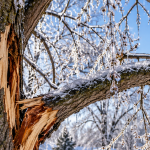
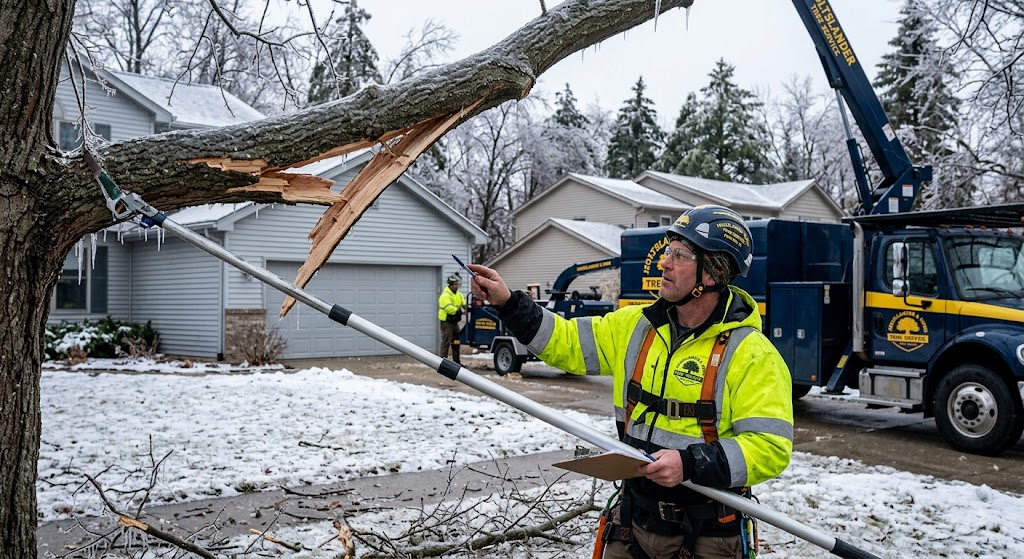
Ice damage typically manifests in three ways. Some branches bend without breaking, flexing under ice weight but remaining attached. Others develop partial splits or cracks, where branch unions or sections of the limb crack but don’t fully separate. The most severe cases involve complete breakage, where limbs snap cleanly or hang by a strip of bark and wood. The severity of damage is influenced by species, because some woods are more brittle, branch age and size, and whether the branch already had structural defects like included bark or decay.
When to Prune Instead of Remove
Not every ice-damaged branch needs to be completely removed. Pruning is often the better choice when damage is limited to the outer portion of the branch, with the main union intact and healthy. It is also preferable when the branch is a key structural limb and removing it entirely would create a large wound and imbalance, when the tree is otherwise healthy and worth preserving for shade, value, or aesthetics, and when the damaged section can be cleanly cut back to a healthy lateral or the branch collar without leaving a large stub. In these cases, targeted pruning removes the compromised portion while preserving the rest of the branch and maintaining the tree’s structure.
When Full Removal Is the Safer Option
Full branch removal, or even whole-tree removal, may be necessary when the branch is split through the main union or trunk, with included bark or extensive cracking. It is also warranted when the limb is large, heavy, and positioned over a house, driveway, or high-traffic area, with uncertain stability. Species prone to decay and poor compartmentalization, such as silver maple or Bradford pear, often cannot safely retain severely damaged limbs. When multiple major limbs are damaged, leaving the tree structurally compromised and unlikely to recover safely, removal is usually the safer choice. Trees that already had significant defects such as decay, prior failures, or severe lean before the ice event often should not be preserved.
Why Timing and Technique Matter
After an ice storm, there is pressure to clean up fast. But hasty, improper cuts can leave large stubs that invite decay, create new weak points that fail in future storms, and stress the tree by removing too much live canopy at once. Proper pruning follows ANSI A300 standards, with clean cuts just outside the branch collar, no flush cuts into the trunk, and selective removal rather than indiscriminate topping. For large or high-risk limbs, professional rigging and sectional removal may be needed to avoid dropping heavy pieces on structures or landscapes.
Common Scenarios in Michigan Yards
Typical ice-damage scenarios include –
- Large oak limb split at a co-dominant union: Often requires complete limb removal to prevent trunk failure and improve tree stability.
- Silver maple with bent and cracked outer branches: Can usually be preserved through selective pruning to remove damaged limbs while maintaining the tree’s structure.
- Bradford pear with multiple shattered limbs: Frequently requires complete tree removal because of weak wood, poor branch structure, and a high risk of future failure.
- Professional assessment: The right solution depends on the extent of the damage, the tree species, the likelihood of future failure, and the tree’s long-term health and viability.
In each case, the decision is guided by risk, species behavior, and long-term tree viability.
Michigan-Specific Considerations
Michigan’s climate adds complexity. Freeze–thaw cycles can enlarge cracks in damaged wood. Heavy snow following ice can add further load to already-stressed limbs. Some species common in Michigan, such as – silver maple, boxelder, and Bradford pear, are especially prone to ice-related breakage. Local arborists understand which species and sites are most vulnerable and can prioritize work accordingly.
Holtslander & Sons Tree Service provides fast, professional response to ice-storm damage across Southeast Michigan. Our team offers 24/7 emergency service for hazardous, ice-damaged trees and limbs, along with expert assessments to determine whether branches can be safely pruned or require removal.
Using specialized equipment, Holtslander & Sons Tree Service performs safe tree work near homes and utilities while assisting with insurance documentation for storm-related claims. Every project includes a transparent written estimate with no hidden costs. Our assessment process begins with securing hazardous limbs, followed by a thorough inspection of the tree’s condition. We then recommend the safest solution, whether targeted pruning to preserve the tree or controlled removal when damage is beyond repair. Every job concludes with complete cleanup to leave your property safe and tidy. Call our team now at – (248) 290-9906 to Book Your Free Estimate !!
Frequently Asked Questions About Ice-Damaged Branches in Michigan
How soon after an ice storm should I have trees assessed in Michigan?
As soon as it’s safe to do so. Hanging or split limbs can fail without warning, especially with wind or additional snow. Immediate assessment helps prioritize the most dangerous situations.
Can I prune small ice-damaged branches myself?
Small, low-risk branches can be pruned by homeowners with proper tools and knowledge. However, avoid climbing, working near power lines, or cutting large limbs. For anything overhead or near structures, call a professional.
Will my tree recover after losing major limbs to ice?
Many trees can recover if enough healthy canopy remains and the remaining structure is sound. Species with poor wood strength or extensive decay may not be good candidates for preservation.
Can ice-damaged branches fall weeks after an ice storm?
Yes. Even if a branch stays attached after the storm, hidden cracks can worsen during freeze-thaw cycles or high winds. That’s why it’s important to have damaged trees inspected as soon as possible.
Which Michigan tree species are most likely to suffer ice damage?
Silver maple, boxelder, Bradford pear, willow, and older ash trees are among the most vulnerable due to their brittle wood or weak branch structure. Oaks and other hardwoods can also experience significant limb failures during severe ice storms.
Does homeowners insurance cover ice-damaged tree removal?
Many homeowners insurance policies cover tree removal if a fallen or damaged tree strikes a home, garage, fence, or other insured structure. Coverage for removing trees that fall without causing property damage varies by policy, so it’s best to review your insurance or speak with your provider.
Can pruning ice-damaged branches improve the tree’s long-term health?
Yes. Proper pruning removes damaged wood before decay spreads, reduces future failure risk, and helps the tree direct its energy toward healthy growth. Clean cuts made by a certified arborist also encourage better wound closure.
Should I wait until spring to prune ice-damaged branches?
Not necessarily. Hazardous or broken branches should be addressed immediately to eliminate safety risks. Minor cosmetic pruning can sometimes wait, but a professional inspection will determine the safest timing based on the tree species and extent of the damage.
Summary Checklist: Ice-Damaged Branch Decision – Michigan
| Task | Priority | Recommended Action |
| Stabilize Hanging or Split Limbs Immediately | Critical | Call emergency tree service for hazardous limbs. |
| Assess Extent of Damage on Each Branch | High | Note cracks, splits, union involvement, and location. |
| Decide Prune vs. Remove Based on Risk and Species | High | Use professional assessment for large or high-risk limbs. |
| Perform Proper Pruning Cuts on Salvageable Branches | High | Follow ANSI standards. Avoid stubs and flush cuts. |
| Remove Unsalvageable Limbs or Trees Proactively | High | Prevent future failures and property damage. |
| Document Damage for Insurance | Moderate | Take dated photos before cleanup if safe. |
Final Advice
Ice-damaged branches should never be ignored, even if they appear stable after a storm. Inspect your trees as soon as conditions are safe, paying close attention to cracked, hanging, or partially split limbs. If damage is limited, proper pruning can remove weakened wood while preserving the tree’s health and structure. However, branches with deep splits, compromised unions, or heavy overhangs near homes or driveways are often safer to remove.
Avoid making improper cuts, as they can increase the risk of decay and future branch failure. Michigan’s freeze-thaw cycles can worsen hidden damage over time, making early assessment especially important. Monitoring your trees after winter storms and addressing problems promptly helps reduce safety risks, encourages healthy recovery, and protects your landscape for years to come.
Holtslander & Sons Tree Service provides 24/7 ice-storm response, hazard assessments, and precise pruning or removal for properties across Fenton, Grand Blanc, Brighton, Howell, Milford, and surrounding Southeast Michigan. For emergency help, call our team now at – (248) 290-9906 to Book Your Free Estimate !!