July 2, 2026
The most dangerous time for trees in Genesee County is not the middle of winter. It is the late season, when ice storms hit in March and April just as trees are beginning to come out of dormancy. The temperature line that produces freezing rain instead of snow tends to set up across mid-Michigan during these transitional weeks, dropping heavy ice loads on branches that are simultaneously starting to push sap and prepare for leaf out.
When that combination hits, branches fail. They fail on trees that looked perfectly healthy the day before. They fail on properties whose owners had no idea anything was wrong. They fall on roofs, cars, power lines, fences, and people.
Key Takeaways
- Late-season ice storms in March and April are often more damaging to Michigan trees than mid-winter storms because they hit trees that are already stressed and beginning to break dormancy.
- The March 2023 ice storm across mid-Michigan caused widespread infrastructure damage and tree failures that continued to surface for weeks afterward as hidden damage became visible.
- Trees that survive an ice storm without obvious damage often carry internal cracks, compromised unions, and weakened root systems that fail during the next wind event months later.
- Silver maples, willows, birches, Bradford pears, and EAB-killed ash trees are the species most prone to catastrophic ice damage in Genesee County.
- Post-storm inspection of large trees near homes is one of the most important tree care actions a Genesee County homeowner can take, often more important than the storm cleanup itself.
This guide explains why late-season ice storms cause the damage they do, why apparently healthy trees can fail without warning, what Genesee County homeowners should be checking for after every ice event, and what to do when something has gone wrong.
Why Late-Season Ice Storms Are Worse Than Mid-Winter Ones
The math of ice loading on tree branches is brutal. A half-inch coating of ice can add 30 times the normal weight to a branch. A full inch of ice on a large oak or maple can add hundreds of pounds of load distributed across the canopy. Mid-winter trees are dormant, with hardened wood and tight buds, and they can sometimes carry these loads.
Late-season trees are not in the same condition.
SAP has started moving
By mid-March in Genesee County, trees have begun the early stages of breaking dormancy. Sap is moving. Cellular activity is increasing. The wood is softer and more flexible than it was in January. This makes branches more prone to cracking under sudden weight load.
Buds Are Swelling
Tight winter buds become swollen, water-filled spring buds. The added moisture in the canopy increases the surface area that ice can accumulate on. Trees that would have carried an ice load in January often cannot carry the same load in late March.
Soil Conditions Compound the Problem
The freeze-thaw cycles of late winter and early spring saturate the soil. Roots sit in heavy, wet ground that loses anchoring strength. A tree that takes an ice load on top of a saturated root zone is at much higher risk of uprooting than the same tree in dry ground.
Wind After Ice
Late-season ice storms in Michigan are frequently followed by strong wind events as warmer air masses move in behind the storm. Branches that survived the initial ice loading then face wind loads on top of the residual ice still attached to the canopy. This sequence produces many of the failures that happen 24 to 72 hours after the storm itself ends.
The March 2023 Ice Storm and What It Showed Us
The late-February through early-March 2023 ice storm across mid-Michigan provided a clear case study in how much damage late-season ice can do. According to the National Weather Service Detroit/Pontiac office, the storm dropped significant ice across Genesee County and the surrounding area. Power outages affected hundreds of thousands of customers. Tree damage was extensive.
The lessons from that event:
- Damage continued to surface for two to three weeks afterward as cracked branches that held initially failed in later wind events
- Some of the most catastrophic failures happened on trees with no visible storm damage from the ground
- EAB-killed ash trees collapsed disproportionately, often without warning
- Bradford pear and silver maple unions split widely throughout the affected area
- Homeowners who walked their properties carefully in the week after the storm caught hidden damage before it became dangerous; those who did not, often did not
This was not an isolated event. Late-season ice storms of similar magnitude have hit Genesee County repeatedly over the past two decades.
Why Healthy-Looking Trees Fail Without Warning
This is the most important point in the article: a tree that looks fine after an ice storm may not be fine. The failures that happen weeks or months later usually trace back to damage that was already present but hidden.
Internal Cracks
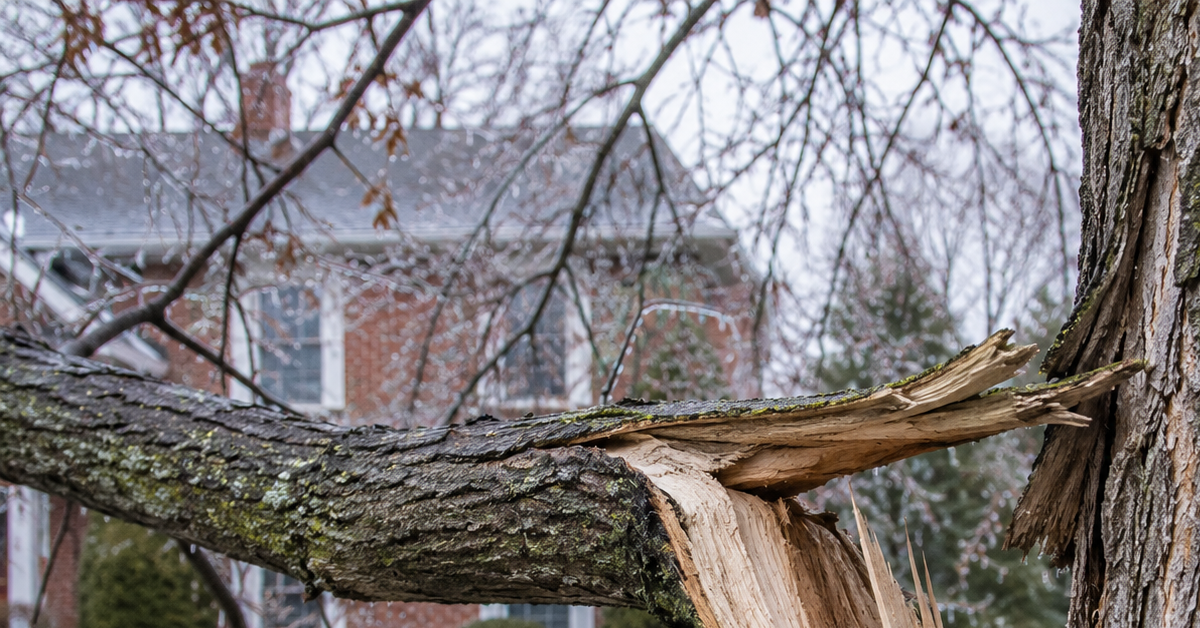
When a branch flexes beyond its tolerance under ice load, the wood fibers separate internally. The bark may remain intact. The branch may even appear to spring back to its original position. But the wood itself has cracked along the grain, and the union or limb is now weaker than it appears.
These cracks become failure points months later when the same branch faces a summer wind event or carries a full leaf load.
Compromised Branch Unions
Trees with included bark unions (where two trunks or large branches grow together with bark trapped between them) are especially vulnerable to ice damage. The ice load can begin separating the union without breaking it completely. The union now has a structural weakness that did not exist before the storm.
Silver maples in Genesee County are particularly prone to this pattern.
Root System Damage
Heavy ice on a saturated root zone can shift a tree slightly without uprooting it. The tree appears upright. But the root system has lost some of its anchoring connections to the soil. The next high wind event finds that weakness and the tree comes down.
A subtle sign is heaved or cracked soil on the upwind side of a leaning tree, often visible only on close inspection.
Crown Damage Hidden by Foliage Later
After leaves emerge in May and June, damaged sections of the canopy can be hidden by surrounding healthy growth. Branches that should have been visibly dead are concealed inside a leafy canopy. The first sign of a problem is often the branch coming down.
Species Most at Risk in Genesee County
Some species fail predictably under ice load. In Genesee County, the highest-risk species are:
- Silver maple: Weak wood, included bark unions, common across older neighborhoods in Fenton, Flint, Grand Blanc, and Burton. The single most common ice-damaged species in the area.
- Willow: Brittle wood, drooping habit, often planted near water. Catastrophic limb failure is common.
- Birch: Multi-trunked specimens with included bark are especially prone to ice splits.
- Bradford pear: Notorious for vertical unions that split apart under ice load. Most Bradford pears in Genesee County do not survive their first significant ice storm intact.
- EAB-killed ash: Dead ash wood is brittle. Standing dead ash trees often shed major limbs or full trunks during ice events without warning.
- Honey locust: Often plagued by weak unions and prone to limb failure.
More resilient species include white oak, sugar maple, ginkgo, and most conifers, though even resilient species can fail under sufficient ice load.
What to Inspect After Every Ice Storm
This is the part most homeowners skip. After the storm passes and the obvious cleanup is done, large trees on the property need a deliberate walk-around inspection. What to look for:
- Hanging or partially broken branches still caught in the canopy: These are called widow-makers for a reason. They can come down at any time.
- Vertical cracks running up the trunk: Especially on the south and southwest sides of thin-barked species like maples.
- Splits at branch unions: Look up into the canopy and check whether large branches still meet the trunk cleanly. Any visible gap or partial separation is a serious problem.
- Heaved or cracked soil at the base: Often visible on the upwind side of leaning trees.
- Mushrooms, fungal conks, or punky wood at the base: Existing decay that is now under increased load.
- Bark damage or sap leaking: From cracks or impact points.
- Sudden lean that was not there before: Compare to photos from earlier in the year if you can.
Walk the property in good light and use binoculars to inspect the upper canopy. Photograph anything that looks suspicious.
What to Do If You Find Hidden Damage
Damage assessment after a storm is one of the most important roles an ISA Certified Arborist plays. What homeowners can see from the ground is often only part of the picture. A trained arborist climbing or using aerial equipment can identify cracks, splits, and decay that are invisible from below.
If you find any of the warning signs above:
- Photograph the damage with the date
- Do not park vehicles or place valuables under the affected tree
- Keep children and pets clear of the area
- Call an arborist within days, not weeks
- Document the damage for insurance purposes before any cleanup happens
If a damaged tree is leaning toward a structure or hanging branches are over a high-traffic area, treat it as an emergency.
What We Commonly See In The Field
The pattern after every major ice storm is consistent. The first wave of calls comes during and immediately after the storm: trees on houses, blocked driveways, limbs over power lines. The second wave comes one to three weeks later as homeowners notice things they missed the first time. The third wave comes in May and June as warming temperatures and wind events find the cracks that were created in March.
The most common damage we see on inspections in the weeks after a late-season ice storm:
- Silver maple branch unions that have separated without fully breaking
- Vertical trunk cracks on maples and birches
- Crown loss on EAB-killed ash trees that should have been removed before the storm
- Bradford pears with completely split V-shaped trunks
- Hanging widow-maker branches caught in the canopies of large trees
The properties that came through the storm best were not the ones with the strongest trees. They were the ones where the largest trees had been professionally inspected and pruned in advance.
What Genesee County Homeowners Can Do Right Now
If a storm has just hit:
- Stay away from any tree leaning toward a structure or power line
- Call your utility immediately if any limbs are touching service drops
- Photograph all damage with the date for insurance documentation
- Do not climb on damaged trees or attempt cuts above shoulder height
- Schedule a professional inspection within a week, especially for large trees near the house
If you are preparing for ice season:
- Schedule a fall risk assessment on any large tree near a structure
- Have weak unions, dead branches, and structural defects addressed before winter
- Remove EAB-killed ash trees before they become storm hazards
- Stop authorizing topping, which creates weak attachments that fail in ice (see our separate guide on tree topping)
- Confirm that your homeowner’s insurance covers tree damage and tree removal under storm events
When to Call a Certified Arborist
Late-season ice damage assessment is exactly the situation an ISA Certified Arborist is trained for. Verifiable credentials through the ISA Find an Arborist directory confirm that the person inspecting your trees has the training to identify damage that is not visible from the ground.
Same-day or same-week assessment is appropriate after any significant ice event. Routine seasonal inspection on large trees near structures should happen at least once a year regardless of recent weather.
Frequently Asked Questions
Are late-season ice storms really worse than winter ones for trees?
In many cases, yes. Late-season ice storms hit trees that are already breaking dormancy, with softer wood and saturated soil, often followed by wind events that compound the damage.
Why does my tree look fine after the storm but fail later?
Ice damage often creates internal cracks, compromised branch unions, and root system shifts that are not visible from the ground. These hidden problems fail during the next wind event, sometimes months later.
Does homeowners insurance cover ice storm tree damage?
Insurance typically covers tree removal when a tree falls on a covered structure during a storm. Policies vary on tree-only damage and proactive removal of damaged trees. Confirm with your insurance agent.
Which trees are most likely to fail in a Michigan ice storm?
Silver maple, Bradford pear, willow, birch, EAB-killed ash, and honey locust are the highest-risk species in Genesee County. More resilient species include white oak, sugar maple, and most conifers.
How soon after an ice storm should I have my trees inspected?
Within a week is ideal for large trees near structures. Earlier if you see hanging branches, splits, or sudden leans.
Can a damaged tree be saved or does it need to come down?
It depends on the type and extent of damage. Cracked branches can sometimes be cabled or pruned out. Split unions and major trunk cracks usually require removal. A professional assessment determines which is which.
What is a widow-maker and why is it so dangerous?
A widow-maker is a broken branch hanging in the canopy that has not yet fallen. They can come down at any time without warning, often when no one expects it. They are responsible for many tree-related injuries every year.
How can I prepare my trees for next year’s ice storms?
Schedule a fall structural inspection on large trees, address weak unions and deadwood before winter, remove dead or dying ash trees, and avoid topping or other practices that create weak attachments.
Call Holtslander & Sons for Post-Storm Tree Inspection in Genesee County
If a late-season ice storm has just hit Genesee County and you are not sure what you are looking at on your property, the right move is a same-week inspection. Hidden damage from ice events tends to surface during the next wind event, often when it does the most damage.
Reach Holtslander & Sons Tree Service for storm damage assessment, hazard pruning, and emergency tree response across Fenton, Linden, Grand Blanc, Flint, Holly, and the broader Genesee County area.